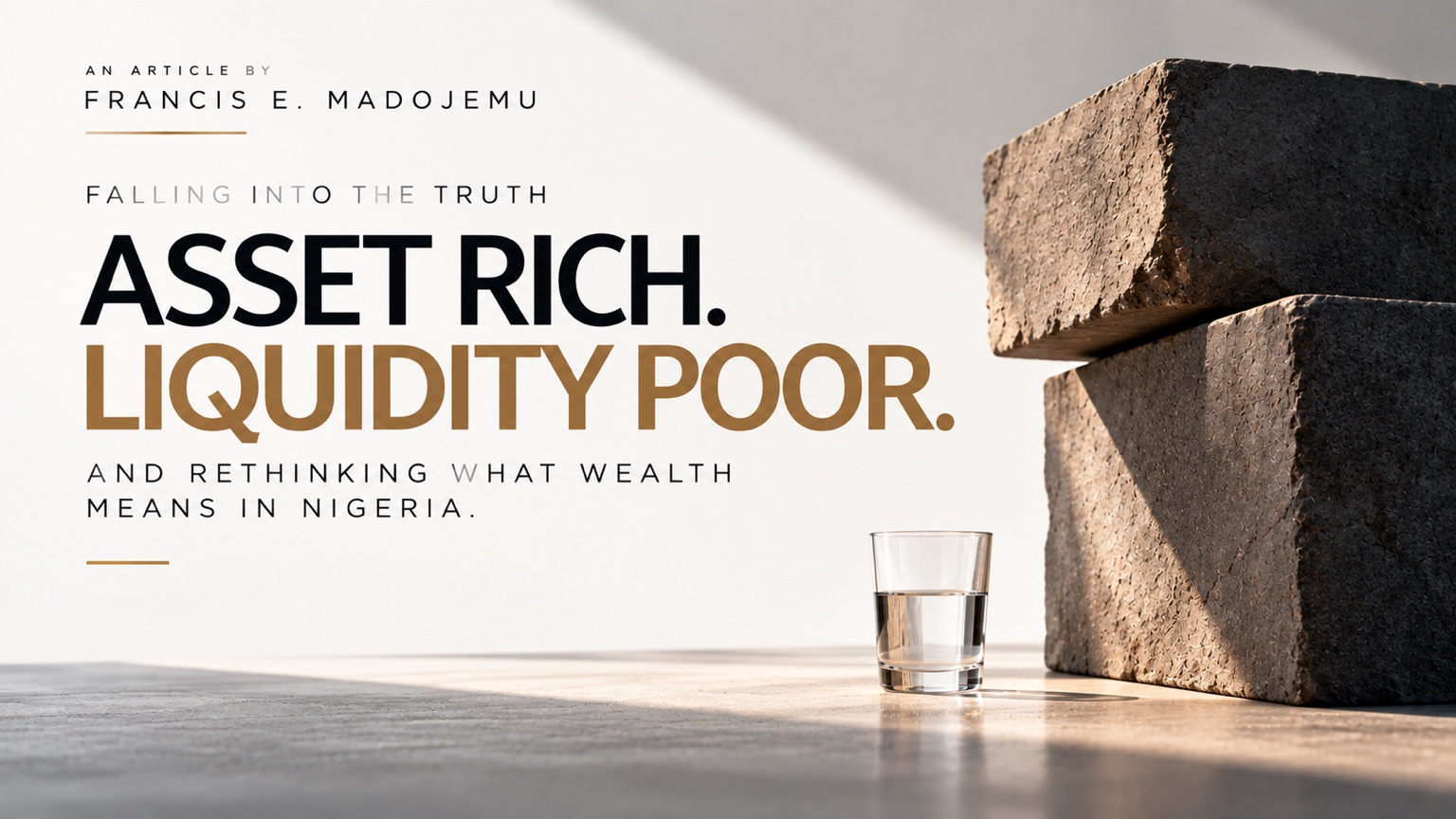
ASSET RICH. LIQUIDITY POOR.
And Rethinking What Wealth Means in Nigeria
By Francis E. Madojemu
Something happened to me on Sunday.
It was not that I heard something completely new.
In fact, that may be what made it more disturbing.
Dr Abib Olamitoye has been talking to us about saving for years. He has lived what he teaches. He has built businesses, hospitals, hotels and investments over decades, and his argument has remained remarkably consistent.
But on Sunday, something I had heard before suddenly became something I could see.
I fell into the truth.
There is a difference.
Sometimes we know something intellectually for years without allowing it to rearrange the way we live.
Then suddenly something happens and the pieces connect.
That happened to me when the conversation turned to liquidity.
THE QUESTION I HAD NOT BEEN ASKING
A gentleman in our congregation explained that instead of keeping money in the bank, he preferred keeping more stock in his business.
I understood him perfectly.
In fact, I realised that I had been doing essentially the same thing for years.
Not necessarily with stock.
With assets.
Land.
Buildings.
Equipment.
Property.
Whenever my savings accumulated to a certain point, I would look at inflation, look at what was happening to the naira, and think:
I cannot leave this money here.
So I would convert it into an asset.
And in Nigeria that is hardly irrational.
We have watched prices rise dramatically.
We have watched the naira lose enormous purchasing power.
We have watched the cost of equipment, vehicles, building materials, food, healthcare, education and almost everything else move beyond what many of us could previously have imagined.
So many Nigerians learnt a survival instinct:
Do not hold too much cash. Buy something.
Buy land.
Build.
Buy equipment.
Stock goods.
Buy foreign currency.
Put the money somewhere before inflation eats it.
I have lived by some version of that thinking for a very long time.
There is truth in it.
But on Sunday I discovered that a truth can be true and still be incomplete.
INFLATION REALLY IS A THIEF
One of my favourite thinkers, Dennis Prager, uses a wonderfully simple description:
Inflation is a thief.
That language makes sense to me.
Inflation quietly punishes the person who did what responsible people were traditionally told to do:
Work.
Save.
Put something aside.
Wait.
Then you return to your money and discover that although the number in the account has not changed, what the money can buy has.
That is a peculiar kind of robbery.
No one entered your bank account.
Nothing technically disappeared.
But your purchasing power was stolen.
That fear has shaped much of my own behaviour.
It helps explain why I repeatedly moved money into assets whenever I saw inflation rising.
I was trying to get away from the thief.
But I now realise that in running away from one danger, I created another.
YOU CAN PROTECT VALUE AND STILL LOSE FREEDOM
Dr Abib kept talking about liquidity.
That word can sound like financial grammar.
It really means something very simple:
Money you can actually get your hands on when you need it.
If I own property worth ₦100 million but cannot raise ₦5 million this week without selling something, borrowing money or waiting for somebody to pay me, I may be wealthy on paper while still being unable to act.
That is a liquidity problem.
Suddenly I saw my own situation differently.
I have assets.
But there have been opportunities I could not take because money I had earned had already been converted into things.
Valuable things.
But things nonetheless.
I said publicly on Sunday:
I am struggling in business right now because I am not liquid. When opportunities show up, I cannot always take them.
That was not financial advice.
It was confession.
Later I admitted something else.
For years, when savings accumulated and I saw inflation eating into their value, I would quickly buy an asset in the hope that the asset would preserve the money and provide cash when I eventually needed it.
Often it did the first.
It did not always do the second.
The asset still had value.
But the value was locked inside the asset.
I had protected myself against one danger and exposed myself to another.
That was my moment of truth.
THEN I SAW FOLAJOMI’S VIDEO
Shortly afterwards I came across a short video from Folajomi.
His language was almost brutal in its simplicity:
You can be asset rich and liquidity poor.
He spoke about people owning plots of land everywhere but still having to look for emergency cash.
And then came the sentence that stayed with me:
“Land appreciates, but rent sustains.”
That is worth thinking about.
Land can increase tremendously in value.
But land sitting somewhere does not buy groceries.
It does not pay electricity bills.
It does not pay salaries.
It does not pay for healthcare.
It does not put money into your account every month.
An asset can make you richer without necessarily making your life financially easier.
At this stage of my life, that distinction is becoming increasingly important.
I AM 64. THIS IS NO LONGER AN ACADEMIC QUESTION.
My wife and I have recently begun having another conversation.
What will it actually cost us to live when I am no longer actively running everything?
Not merely survive.
Live.
Maintain a reasonable version of the life we have become accustomed to.
Look after our home.
Deal with healthcare.
Travel when necessary.
Give.
Support the work we believe in.
Remain useful.
And not become financially dependent on our children.
That question changes everything.
Because retirement is not really:
How much are all your assets worth?
A more uncomfortable question is:
How much money comes into your household every month when you stop working?
Suppose we eventually determine that our household needs ₦3 million every month.
Where does that ₦3 million come from?
Not:
“How much property do we own?”
Not:
“How much land do we have?”
Not:
“How much is the business worth?”
But:
What puts ₦3 million into our account every month without requiring me to return to work to generate it?
That is a very different question.
And it is not merely retirement planning.
It is succession planning.
I want to hand things over.
The business.
Leadership.
Ministry responsibility.
Decision-making.
But if I keep having to return because my livelihood still depends upon my involvement, then technically I have not really handed over.
Financial independence is part of successful succession.
Sunday’s conversation already contained this question.
I had recently given my wife an Excel sheet and asked her to calculate what we would realistically need each month so that one day we could step back and know that the money required to live would arrive without our children having to support us.
The liquidity conversation suddenly gave that exercise much greater meaning.
INFLATION DOES NOT ROB EVERYBODY IN THE SAME WAY
There is another part of this conversation we cannot ignore in Nigeria.
Inflation does not affect everybody equally.
That does not mean every wealthy person automatically becomes richer when prices rise.
Life is more complicated than that.
But people who already own businesses, income-producing property, foreign-currency assets or other investments often have more ways to defend themselves.
A business may be able to increase prices.
Rent may eventually be reviewed.
An investment may appreciate.
Foreign-currency holdings may preserve part of someone’s purchasing power when the naira weakens.
The poorest household often has almost no defence.
Most of the income disappears immediately into food, transport, shelter and basic survival.
But there is another group that concerns me greatly:
THE DIMINISHING MIDDLE CLASS.
These are often responsible people.
Teachers.
Managers.
Civil servants.
Professionals.
Bankers.
Pastors.
Small-business owners.
Salary earners.
People who went to school, obtained qualifications, worked hard, saved something and built what we once called a comfortable life.
Then inflation begins to move faster than their salary.
The salary may remain ₦500,000.
But the school fees change.
The rent changes.
Food changes.
Petrol changes.
Electricity changes.
Healthcare changes.
Transport changes.
Even when the salary eventually becomes ₦600,000 or ₦700,000, the lifestyle that ₦500,000 once supported may now require ₦1 million.
Nothing dramatic has happened to the person.
He has not lost his job.
She has not suddenly become irresponsible.
But their purchasing power has fallen.
They are earning more money while becoming poorer.
That is what makes the shrinking middle class so disturbing.
You once travelled.
Now you postpone it.
You once replaced the car.
Now you keep repairing it.
You once sent the children to a certain school.
Now the fees are becoming uncomfortable.
You once ate out without thinking very much about it.
Now you calculate.
You once saved after paying your expenses.
Now the month sometimes finishes before the expenses do.
Nobody announces:
“Today you have left the middle class.”
It happens quietly.
One compromised decision at a time.
That is why inflation really is a thief.
BUT THERE IS ANOTHER THIEF: LIFESTYLE
This is where another writer I have learnt greatly from, Morgan Housel, challenged me in a different direction.
Housel talks about what he calls social debt.
As people’s income rises, expectations surrounding their lives often rise with it.
Bigger house.
Better car.
Better schools.
More travel.
More responsibilities.
More people expecting help.
More lifestyle to maintain.
Housel points out that even an ordinary salary increase can quickly become accompanied by an increase in the expected standard of living.
That matters enormously when thinking about retirement.
My wife and I cannot simply ask:
How much money can our investments produce?
We must also ask:
What life have we built that the money must sustain?
That is a much more uncomfortable conversation.
Because retirement planning is not only about investments.
It is also about expectations.
Housel makes another point I find increasingly important: one of the most valuable financial advantages a person can possess is not needing to impress everybody else.
At 64, that sounds increasingly profound.
The goal cannot be to maintain every symbol of success forever.
The goal must be to construct a life that is:
sustainable, dignified, generous, and free.
SO MY WIFE AND I ARE RETHINKING OUR MONEY
I am not writing this as someone who has solved the problem.
That matters to me.
I cannot tell people to do things I am unwilling to do myself.
I am writing as someone who has realised he needs a better structure.
At the moment I am beginning to see at least four different kinds of money.
Not technical categories.
Just different jobs.
1. MONEY WE NEED NOW
We need naira available for ordinary life and business.
Bills.
Food.
Emergencies.
Repairs.
Unexpected situations.
Opportunities.
That money must be accessible.
That is liquidity.
We cannot put every naira into property and then start looking for a loan when the generator breaks down.
But neither do I want unnecessarily large amounts sitting idle while inflation quietly reduces what they can buy.
So the question becomes:
How much genuinely needs to remain immediately available?
That is a number my wife and I now need to calculate.
2. MONEY THAT CAN EARN WHILE IT WAITS
This is where I am beginning to look differently at Treasury Bills, money-market funds and other relatively short-term investments.
I am deliberately using ordinary language because I am trying to understand these things practically myself.
A Treasury Bill is essentially a short-term way of lending money to the Federal Government and receiving a return.
A money-market fund gathers investors’ money and places it largely into relatively short-term financial instruments.
Neither is magic.
Returns change.
Inflation can still reduce the real value of what you earn.
There are risks and fees to understand.
But the idea interests me enormously:
Does money that I may need relatively soon have to sit completely idle while I wait?
Perhaps not.
Perhaps part of our future household reserve can remain reasonably accessible while earning something.
That is very different from locking everything inside another building.
3. SOME MONEY MAY NEED TO BE IN DOLLARS
This is also something we are now considering.
Not because I believe everybody should rush out and buy dollars.
And certainly not because I know where the exchange rate will be next year.
I don’t.
This is where another Housel principle becomes useful.
He says he does not try to build his financial life around predicting precisely what the economy or markets will do next.
Instead, he tries to arrange his finances and his behaviour so that he can absorb whatever surprises arrive.
That makes sense to me.
So instead of asking:
Will the dollar go up?
Perhaps the better question is:
What future things will my wife and I probably need to pay for in foreign currency?
Travel?
Medical treatment?
Subscriptions?
Equipment?
Supporting family abroad?
Other commitments?
If some future obligations are effectively in dollars, perhaps part of our savings should also be in dollars.
Not gambling on the exchange rate.
Simply matching some future needs with the currency in which those needs may arise.
That I can understand.
4. MONEY THAT MUST KEEP PAYING US
Then comes the biggest question.
What pool of capital can eventually produce the monthly income required for our lives?
This could involve different things.
Income-producing property.
Treasury instruments.
Funds.
Businesses that can distribute profit without my daily involvement.
Other investments.
Probably a combination rather than one magical answer.
What matters to me now is the outcome:
Money must arrive whether I go to work that morning or not.
That, for me, is beginning to define retirement income.
AND THEN THERE ARE THE ASSETS WE ALREADY OWN
This may become the hardest part of the exercise.
My wife and I may discover that we own assets that are valuable but are not really serving the future we now need to build.
That raises an uncomfortable question:
Should some assets be sold in order to create the income-producing and liquid capital we presently do not have?
I am not answering that lightly.
Selling an asset merely to consume the proceeds solves nothing.
Selling a good asset because of temporary pressure could be foolish.
But perhaps there is another category.
An asset that:
is worth substantial money,
produces little or no income,
costs money to maintain,
is not essential to our future,
and represents capital we badly need somewhere else.
That asset deserves a conversation.
Perhaps the question is no longer:
How many assets do we own?
Perhaps it is:
WHAT JOB IS EACH ASSET DOING?
Is it our home?
Is it preserving value?
Is it producing income?
Is it supporting the business?
Is it appreciating for a specific future purpose?
Is it costing us money?
Or is it simply sitting there because owning assets has always made me feel safe?
That final question is difficult.
But necessary.
AT 64, A “GOOD ASSET” MAY MEAN SOMETHING DIFFERENT
A piece of land may double in value.
Excellent.
But if it produces nothing for ten years, that may be perfectly acceptable to a 35-year-old.
At 64 or 65, I have to ask another question:
When does this asset begin serving my life?
Time changes the meaning of wealth.
At one stage the goal may be accumulation.
At another stage the goal becomes income.
Then preservation.
Then succession.
Then legacy.
Housel makes a similar point from another direction.
Instead of always asking how to maximise the highest possible return, he increasingly asks whether a strategy can be sustained for decades.
That is beginning to make sense to me beyond investing.
I do not need the cleverest financial arrangement.
I need one my wife and I understand, can live with, and can sustain.
MONEY SHOULD REDUCE ANXIETY, NOT CREATE ANOTHER PRISON
Another Housel distinction has stayed with me.
He separates happiness from contentment.
His point is that money cannot guarantee happiness, but it can reduce some of the anxiety that comes from constantly wondering whether you can meet your obligations.
That may be one of the clearest descriptions of what I want from retirement capital.
Not extravagance.
Not proving anything.
Not becoming richer merely so I can say I am richer.
I want enough structure around our finances that my wife and I can wake up and know:
We are okay.
The bills are covered.
We do not need our children to rescue us.
We do not need to sell something every time there is an emergency.
I do not need to interfere in a business I have supposedly handed over because I need this month’s income.
We can give.
We can serve.
We can make decisions from conviction rather than panic.
That sounds increasingly like wealth to me.
THIS DOES NOT MEAN DR ABIB WAS TELLING US TO KEEP EVERYTHING IN CASH
That would be far too simplistic.
Earlier on Sunday he made it clear that saving is the beginning and that accumulated savings should eventually find their way into investment and reinvestment.
The issue was developing the discipline to accumulate capital in the first place.
And when the businessman said he preferred putting everything into stock, the discussion turned to what Dr Abib called running capital—money available to keep the business going and enable it to grow.
I understand that better now.
The answer isn’t:
CASH OR ASSETS?
It is:
How much must remain available?
How much must protect us against currency loss?
How much should earn while waiting?
How much should generate monthly income?
How much can be locked away for long-term growth?
Those are different jobs.
Maybe my mistake was asking one kind of money to do all of them.
A TRUTH CAN BE TRUE AND STILL BE INCOMPLETE
Perhaps this is the most important thing I took away from Sunday.
I watched myself initially resist an idea because it contradicted the way I had learnt to think.
I had my argument.
Inflation.
Depreciation.
The falling naira.
Assets preserve value.
And none of those things is false.
But neither is this:
Lack of liquidity can cost you opportunities.
Both are true.
That is the danger of an incomplete truth.
We hold it so tightly that we cannot receive the next truth.
I said something to the congregation that morning that I have continued to think about:
You are making a mistake when you stand on a position that has not worked for you and somebody is showing you another way to look at it. Give it a chance before you reject it.
I was talking to them.
I was also talking to myself.
BUILD AGAIN + BETTER
That is why our twentieth-anniversary theme has become even more meaningful to me.
BUILD AGAIN + BETTER.
If God tells you to build again, perhaps something about the previous way of building must be reconsidered.
And if He says build better, repeating yesterday’s method more aggressively cannot be the complete answer.
At some point we have to become humble enough to say:
Maybe there is something I don’t know.
Maybe what protected me yesterday is constraining me today.
Maybe a strategy that was appropriate at 40 needs modification at 64.
Maybe somebody else has seen something I have not seen.
Maybe my truth is true—but incomplete.
Maybe I need to stop defending what I have always done long enough to learn something new.
That may be harder than saving money.
THIS IS WHERE I AM NOW
I do not yet have a perfectly constructed retirement portfolio.
I do not yet have enough capital sitting somewhere producing everything my wife and I will eventually need every month.
I cannot write pretending that I do.
But now I know the questions I need to answer.
What does it actually cost us to live every month?
What will that number look like when I am no longer actively working?
How much income already reaches us without my daily involvement?
What assets are genuinely producing income?
What assets are merely storing value?
What assets might need to be sold?
How much naira should remain liquid?
How much foreign currency should we hold against genuine foreign-currency needs?
How much should be earning while we wait?
And what size of income-producing capital would allow me finally to hand things over without having to return because I need the money?
Those are now real questions in our house.
I don’t yet have all the answers.
And perhaps that is precisely why I needed to write this.
Morgan Housel says some of his best writing begins with questions he genuinely needs to answer for himself.
That is exactly what this is.
I am not standing on the mountain telling everyone else how to climb.
I am somewhere on the mountain myself saying:
I think I just saw something.
And perhaps someone else needs to see it too.
For years my instinct was:
When money accumulates, quickly buy an asset before inflation destroys it.
I am not abandoning that truth.
I am adding another one:
Do not become so successful at storing wealth that you have no money with which to live, move, respond or seize opportunity.
And perhaps one more:
Do not spend your entire life building assets only to discover that you never built the income that would allow you to stop working.
I am 64.
This is no longer theory.
It is succession.
It is retirement.
It is stewardship.
It is freedom.
It is legacy.
And perhaps it is another invitation to fall into the truth.
BUILD AGAIN.
But this time—
BUILD BETTER.
Francis E. Madojemu
ACKNOWLEDGMENTS & SOURCES
This article grew out of a live conversation at The Bridge Network City Church with Dr Abib Olamitoye, whose long-standing teaching on saving, consistency, capital accumulation and liquidity challenged some of my own assumptions about money and business.
I also acknowledge Folajomi, whose short video and memorable distinction between being asset rich and liquidity poor helped crystallise the central tension explored here—particularly the insight that “land appreciates, but rent sustains.”
I am grateful for the thinking of Dennis Prager, especially his framing of inflation as a thief, which describes the very real erosion of purchasing power experienced by responsible savers.
I also draw on the work and interviews of Morgan Housel, author of The Psychology of Money and Same as Ever. His ideas on social debt, sustainability, uncertainty, contentment, personal-finance behaviour and building a financial life capable of absorbing surprise helped me think more clearly about retirement, lifestyle and resilience.
The wider Nigerian context in this article is also informed by publicly available economic data and analysis from institutions including the Central Bank of Nigeria, World Bank and Securities and Exchange Commission Nigeria, particularly around inflation, exchange-rate pressures, household purchasing power and regulated investment instruments.
The conclusions, personal reflections and applications are my own.