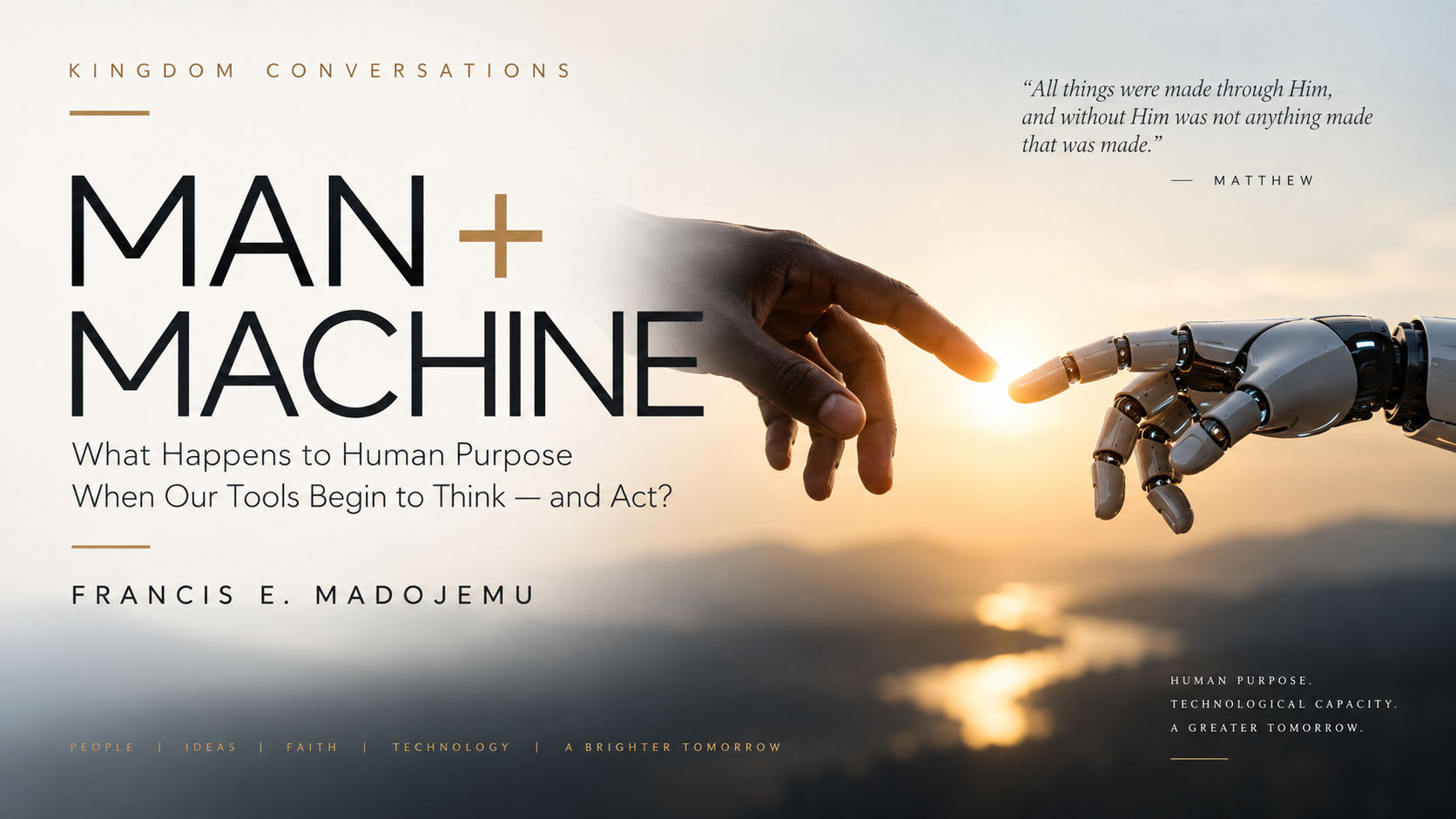
What Happens to Human Purpose When Our Tools Begin to Think—and Act?
Kingdom Conversations
Francis E. Madojemu
Someone recently sent me a beautiful Christian song.
I listened to it. Good music. Beautiful lyrics. Christ-centred. Inspiring.
Then came the question:
“But is it AI?”
And almost immediately the conversation changed.
We were no longer talking about whether the song was beautiful, whether its words were true, whether it helped anyone, or even who wrote it.
We were talking about the machine.
I have been thinking about that reaction.
Because I suspect that the arrival of artificial intelligence is forcing us to confront a much older question:
What is the proper relationship between the human being and the tools the human being creates?
And for Christians there is an even deeper question:
What must remain distinctly human when our machines become increasingly capable of doing things we once considered distinctly human?
I don’t think the answer is to worship the machine.
I don’t think the answer is to fear it either.
Perhaps we need to understand something much older.
Human beings have always been tool builders.
THE BICYCLE
Steve Jobs used to tell a story that has stayed with me.
He recalled encountering research comparing the efficiency of locomotion among different species. Human beings weren’t particularly impressive. The condor did much better.
Then somebody calculated the performance of a human being riding a bicycle.
Everything changed.
The bicycle didn’t make the human biologically stronger. It didn’t replace the human being. It didn’t acquire a destination of its own.
It amplified the human being.
Jobs eventually used this insight to describe the personal computer as a kind of “bicycle for the mind.”
I think that is a remarkably useful way of thinking about technology.
The hammer amplifies the hand.
The telescope amplifies the eye.
The automobile amplifies the legs.
The telephone amplifies the voice.
The printing press amplifies communication.
The calculator amplifies computation.
The computer amplifies information processing.
And artificial intelligence?
Perhaps AI represents another extraordinary leap in the long human history of amplification.
In earlier conversations about AI for the Gospel & the Walk of Faith, I began thinking about tools more broadly—not only physical objects but software, systems and processes. They are ways through which human beings extend capacity.
AI FOR THE GOSPEL & THE WALK OF FAITH.pdf
But AI complicates the story.
Because this bicycle appears increasingly capable of helping decide where to ride.
AN IDEA FROM 1960
Long before ChatGPT, long before the personal computer, an American psychologist and computer scientist named J.C.R. Licklider wrote a remarkable paper.
It appeared in 1960 in IRE Transactions on Human Factors in Electronics.
Its title was:
Man-Computer Symbiosis.
Licklider imagined something different from human beings merely operating machines—or machines simply replacing human beings.
He imagined cooperation.
In his anticipated partnership, human beings would set goals, formulate hypotheses, establish criteria and evaluate results, while computers handled much of the routinizable processing necessary to prepare the way for insight and decisions.
Think about when he wrote that.
1960.
No World Wide Web.
No personal computer in every home.
No smartphone.
No generative AI.
Yet Licklider was already asking something remarkably close to our present question:
What happens when human intelligence and machine capability work together rather than separately?
He called it symbiosis.
More than sixty years later, we are beginning to inhabit something resembling the world he imagined.
But Christianity must add something to Licklider’s formulation.
Because partnership alone cannot answer the question of purpose.
AMPLIFICATION IS NOT DIRECTION
Give me a microphone and my voice becomes louder.
But the microphone cannot determine whether what I say is wise.
Give a good person more capacity and good may travel further.
Give a dishonest person more capacity and dishonesty may travel further.
Give a brilliant physician better diagnostic tools and perhaps more people live.
Give a sophisticated criminal better tools and perhaps more people suffer.
Technology amplifies.
But amplification is morally incomplete.
The question is:
What is being amplified?
And:
Who decides why?
This is where some of the more breathless conversation about artificial intelligence worries me.
We sometimes speak as though increased capability automatically means increased progress.
It doesn’t.
Capacity without character can become catastrophe.
Human history should have taught us that by now.
SCRIPTURE HAS A THEOLOGY OF CAPACITY
The Bible begins with an extraordinary statement about humanity:
“Let us make mankind in our image, in our likeness…”
— Genesis 1:26
Human beings are subsequently given responsibility within creation.
That order matters.
Identity precedes assignment.
We don’t receive our value because of our productivity.
We work from a dignity already bestowed by God.
Then Scripture repeatedly shows human beings creating, cultivating, naming, organising and building.
One of my favourite examples is Bezalel.
In Exodus 31, God speaks about filling him with the Spirit of God, with wisdom, understanding, knowledge and craftsmanship.
Notice what Scripture refuses to separate:
Spirit and skill.
God and craftsmanship.
Wisdom and making.
Divine calling and human technique.
There is nothing inherently unspiritual about becoming exceptionally good at making something.
Deuteronomy 8:18 similarly speaks of God giving people the capacity to produce wealth, while Ephesians 4 presents ministry as equipping God’s people for works of service. These ideas were central to my earlier AI for the Gospel & the Walk of Faith reflections.
AI FOR THE GOSPEL & THE WALK OF FAITH.pdf
Interestingly, this basic connection between human creativity, stewardship and technology is not peculiar to my argument. The 2019 Evangelical Statement of Principles on Artificial Intelligence describes technological creativity as an expression of humanity’s God-given creative capacities while simultaneously insisting that technology must serve human flourishing, the glory of God and love of neighbour.
That gives us a better starting question for AI.
Not merely:
“Can Christians use artificial intelligence?”
But:
“How should God-given human capacity steward this new technological capacity?”
THE CHRISTIAN PROBLEM IS NOT SIMPLY TOOLS. IT IS IDOLATRY.
A hammer can become an idol.
A building can become an idol.
A denomination can become an idol.
A ministry can become an idol.
Money can.
Politics can.
Technology certainly can.
The biblical response to idolatry isn’t necessarily the destruction of every tool.
It is the restoration of order.
God remains God.
Human beings remain image-bearers.
Creation remains entrusted to human stewardship.
Tools remain tools.
Perhaps we need to keep something like this before us:
GOD → HUMAN → MACHINE → MISSION
Not:
MACHINE → HUMAN.
And certainly not:
MACHINE → GOD.
PURPOSE IS NOT TASK
This brings me to something NVIDIA CEO Jensen Huang has expressed that I find enormously helpful.
Discussing software engineering, Huang distinguished the programmer’s task from the larger purpose: writing code is a means; solving problems and discovering new problems worth solving is the larger work.
That distinction matters because:
**PURPOSE IS WHY YOU EXIST.
TASK IS WHAT YOU DO.**
Our earlier Purpose vs Task and Algorithms in the River work developed this further: methods and tasks change across generations, seasons and technologies. Calling lies deeper.
Algorithms_in_the_River_C3_Lagos_Master_Deck_v2_FIXED 2.pdf
Consider Moses.
Shepherding was a task.
Deliverance was an assignment.
David tended sheep.
He played music.
He fought.
He governed.
The tasks changed.
Joseph was a son, slave, administrator, prisoner and governor.
The visible occupation kept changing.
Yet something deeper was unfolding through all of it.
This matters enormously now because AI is beginning to perform tasks people have used to define themselves.
The writer asks:
If AI can write, who am I?
The designer asks:
If AI can design, who am I?
The programmer asks:
If AI can code, who am I?
The accountant asks:
If AI can analyse these figures, who am I?
And perhaps eventually the pastor asks:
If AI can search Scripture, compare commentaries, construct an outline, translate my sermon, answer theological questions and create discipleship materials—who am I?
Perhaps AI hasn’t created that identity crisis.
Perhaps AI has revealed it.
We confused our task with our calling.
YOUR CALLING IS DEEPER THAN YOUR CURRENT TOOL
Suppose tomorrow someone invents a diagnostic instrument vastly superior to the stethoscope.
Has the physician become irrelevant?
Only if the physician thought:
My purpose is to use a stethoscope.
But that was never the purpose.
The instrument serves something deeper.
Likewise, preaching matters profoundly.
But the Kingdom of God doesn’t exist so that I can preach.
Music matters.
Buildings are useful.
Media is useful.
Livestreaming can be useful.
AI may become extraordinarily useful.
But:
THE MECHANISM MUST NEVER BECOME THE MISSION.
This is why technological change terrifies organisations that have confused their methods with their purpose.
When identity is fused to method, every new tool looks like an enemy.
When calling governs method, a new tool creates a different question:
Can this help us fulfil the calling more faithfully?
BUT SOMETHING HAS CHANGED
Until recently, most tools waited.
The hammer waits.
The car waits.
The calculator waits.
Even traditional software largely waits for instructions.
Artificial intelligence is crossing an important threshold.
We are moving from:
AI THAT ANSWERS
toward:
AI THAT ACTS.
The agentic-AI material I’ve been studying describes precisely this shift: from conversation toward execution, from individual prompts toward workflows and increasingly toward coordinated systems of specialised agents.
LinkedIn Post Summary.txt
One researches.
Another analyses.
Another writes.
Another checks.
Another communicates.
Another monitors.
Increasingly, AI systems may coordinate other AI systems.
That begins to look less like a calculator.
And more like a digital workforce.
Now the theological and ethical question becomes sharper.
IF THE MACHINE ACTS, WHO IS RESPONSIBLE?
This may become one of the defining questions of the next decade.
Suppose an AI merely recommends something.
A human decides.
Responsibility seems relatively obvious.
But suppose an agent negotiates.
Purchases.
Schedules.
Rejects an application.
Moves money.
Communicates with a customer.
Controls equipment.
Manages another agent.
Or executes hundreds of actions while the human sleeps.
Who is responsible?
The Christian answer cannot simply be:
“The algorithm did it.”
And here there is remarkable agreement across different parts of contemporary Christianity.
The evangelical AI statement argues that AI may inform and assist human reasoning but that humans must not cede moral accountability to machines.
The Vatican’s 2025 Antiqua et Nova arrives at a closely related conclusion from the Catholic tradition. It argues that moral responsibility remains grounded in the dignity and vocation of the human person and that ultimate responsibility for decisions involving AI must remain with human decision-makers. It also warns against overdependence on AI and against sacrificing human dignity to efficiency.
That convergence is worth noticing.
And it causes me to revise something I previously said.
I once wrote:
“AI does tasks. Humans must still do thinking…”
Algorithms_in_the_River_C3_Lagos_Master_Deck_v2_FIXED 2.pdf
I would no longer make thinking the dividing line so confidently.
AI increasingly performs operations that resemble reasoning, analysis and planning.
The deeper Christian boundary is:
IMAGE. CALLING. CONSCIENCE. RESPONSIBILITY.
A machine can participate in the execution of human vocation without possessing the vocation itself.
That distinction is going to matter enormously.
HUMAN + MACHINE DOES NOT AUTOMATICALLY MEAN BETTER
This is another correction we need to make to technological optimism.
I am excited about Human + Machine.
But the plus sign is not magic.
Bad judgement + powerful AI can produce more powerful bad judgement.
Poor delegation can make us worse.
Blind trust can make us worse.
Dependency can make us worse.
And perhaps most dangerously, a machine that makes difficult things easy can gradually make human beings less capable of doing difficult things.
This is why the formation question may eventually be more important than the productivity question.
WHAT KIND OF PERSON IS THE TOOL MAKING?
Whenever we acquire technology, we ask:
What can it do for me?
We don’t ask often enough:
What is using this doing to me?
GPS makes navigation easier.
But what happens to our own sense of direction?
Calculators make arithmetic faster.
But what happens to mental calculation?
Social media connects us.
But what does constant stimulation do to attention?
Generative AI makes writing easier.
Wonderful.
But if I never struggle to find language for my own thoughts, what happens to my ability to think?
That isn’t an argument against AI.
It is an argument for formation.
And Antiqua et Nova makes a strikingly similar warning: AI should complement rather than diminish human intelligence, and human beings must resist a technological culture that causes non-computable dimensions of human life to be forgotten.
The Christian question therefore isn’t merely:
Is this permissible?
It is also:
WHAT KIND OF PERSON AM I BECOMING?
The Christian cannot outsource the formation of the mind to an algorithm.
HUMAN + MACHINE REQUIRES HUMAN UNDER GOD
This may be the sentence at the centre of everything I’m trying to say.
I believe extraordinary things may emerge from Human + Machine.
Medicine.
Education.
Translation.
Entrepreneurship.
Accessibility.
Creativity.
Scientific discovery.
Government.
Agriculture.
Ministry.
Mission.
The possibilities are enormous.
But:
**HUMAN + MACHINE
REQUIRES
HUMAN UNDER GOD.**
Because fallen human beings plus enormously powerful machines do not automatically produce human flourishing.
We can amplify generosity.
We can also amplify greed.
We can democratise knowledge.
We can also industrialise deception.
We can personalise education.
We can also personalise manipulation.
We can create beautiful Christian music using new tools.
We can also manufacture fake pastors, fake testimonies, fake prophecies and fake miracles.
The machine magnifies capacity.
It cannot sanctify desire.
That remains our problem.
BEZALEL AND BABEL
Perhaps Scripture gives us two useful pictures.
Bezalel represents capacity ordered toward God’s purpose.
Skill.
Craft.
Beauty.
Wisdom.
Making.
Babel represents extraordinary human capacity and coordination ordered toward self-exaltation:
“Let us make a name for ourselves.”
— Genesis 11:4
Both involve human capacity.
Both involve building.
The difference isn’t that one uses technology and the other doesn’t.
The difference is telos.
Purpose.
Direction.
Worship.
We should therefore be careful with simplistic Christian arguments that say:
Technology = Babel.
That isn’t the point.
The deeper warning is:
POWERFUL CAPACITY + DISORDERED PURPOSE = BABEL.
While Bezalel suggests another possibility:
POWERFUL CAPACITY + WISDOM + CALLING + STEWARDSHIP.
That is much closer to the challenge before us.
AND THEN COMES AFRICA
I am particularly interested in what all this means for Africa.
We don’t have to build every foundational AI model before we can participate meaningfully in this revolution.
Our advantage may lie somewhere else.
We know our problems.
Education.
Healthcare access.
Agriculture.
Informal commerce.
Transportation.
Local languages.
Small businesses.
Government services.
Vocational training.
Creative industries.
Church administration.
Diaspora connections.
Logistics.
Financial inclusion.
The opportunity may belong to people who can combine:
**LOCAL KNOWLEDGE
- HUMAN JUDGEMENT
- AI CAPACITY
- GOOD SYSTEMS**
to solve real problems.
The winners need not own all the underlying intelligence.
They may understand the problem and the workflow.
That is why I am increasingly less interested in asking:
“How can I make money from AI?”
And much more interested in asking:
WHAT PROBLEM HAS COME INTO MY SPACE?
Then:
What has become possible because the cost of intelligence, creation, analysis and coordination is falling?
That question may open extraordinary doors for Africa.
THE AGE OF ORCHESTRATION
Perhaps one of the great skills of the coming age will therefore be orchestration.
Not merely prompting.
Not simply knowing how to use the latest AI application.
Can you define the desired outcome?
Can you bring together human beings, AI, processes and information?
Can you decide what should be delegated?
Can you establish boundaries?
Can you recognise failure?
Can you retain accountability?
Can you tell when the machine is confidently wrong?
Can you recognise when efficiency is destroying something human?
Can you design a system without becoming enslaved to the system?
That may be leadership in the age of AI.
Interestingly, Licklider anticipated part of this sixty-six years ago. In his proposed symbiosis, computers could do enormous amounts of processing, but humans remained responsible for goals, criteria and evaluation.
The technology has changed beyond what he could have imagined.
But perhaps the principle remains:
**CAPABILITY CAN BE SHARED.
RESPONSIBILITY CANNOT SIMPLY BE ABANDONED.**
AND YET SOMETHING IS STILL MISSING
Suppose everything I have said works.
Suppose Human + Machine produces extraordinary amplification.
Suppose agents perform work.
Suppose orchestration transforms organisations.
Suppose Africa discovers new economic opportunities.
Suppose churches become technologically competent.
Suppose translation accelerates.
Suppose businesses become ten times more productive.
Suppose individuals acquire capabilities once available only to large organisations.
There remains a question that no increase in capability can answer:
TO WHAT END?
A faster vehicle doesn’t determine its destination.
A more powerful engine doesn’t tell the boat where to go.
Intelligence is not purpose.
Capability is not calling.
Efficiency is not wisdom.
Scale is not significance.
And technology is not destiny.
THERE IS A RIVER
This is where my thinking about artificial intelligence has unexpectedly collided with something much larger in my Christian walk.
The River.
There is a remarkable movement of river and living-water imagery across Scripture.
A river flows out of Eden in Genesis 2.
Psalm 46 speaks of a river whose streams make glad the city of God.
Ezekiel sees water flowing from the temple, becoming deeper as it moves outward and bringing life wherever it goes.
Jesus speaks of living water—and John explicitly connects that imagery with the Spirit.
And Revelation 22 ends with the river of the water of life flowing from the throne of God and of the Lamb, with the tree of life and the healing of the nations.
I don’t want to flatten all of those passages into a single simplistic symbol. That deserves a much deeper study of its own.
But together they have helped me see something.
History is not ultimately the story of technology.
It is not ultimately the story of artificial intelligence.
It isn’t even ultimately the story of human ingenuity.
The Christian story is about God, His Kingdom, His purposes, His creation and ultimately His new creation.
Which leads me to a sentence that has become increasingly important to me:
**AI IS NOT THE RIVER.
THE KINGDOM IS.**
Suddenly the machine finds its proper place.
The machine may become an engine.
But the engine is in a boat.
The boat is in a River.
And the River has a source and destination that neither the boat nor the engine created.
So perhaps the final question of the AI age isn’t:
How intelligent will the machine become?
Perhaps it is:
WILL INCREASINGLY POWERFUL HUMAN BEINGS KNOW WHERE THEY ARE GOING?
Because the machine may amplify us beyond anything previous generations imagined.
But amplification without direction simply enables us to become lost more quickly.
MAN + MACHINE IS NOT THE END OF THE STORY
I began with a song.
Was AI involved?
Yes, in some way.
But I now think the more interesting questions are:
Who imagined it?
Who wrote it?
What was the machine asked to contribute?
Was anybody deceived?
Was what it communicated true?
Did the technology amplify something worth amplifying?
Who remains responsible for what was created?
And ultimately:
WHAT DOES IT SERVE?
Those questions move us beyond the sterile choice between worshipping technology and fearing it.
The future is unlikely to be simply:
MAN OR MACHINE.
It increasingly looks like:
MAN + MACHINE.
But Christianity must insist upon something more:
**MAN + MACHINE
UNDER GOD
FOR THE GOOD OF THE WORLD.**
And that means my next conversation cannot really be about artificial intelligence.
It has to be about direction.
Calling.
Kingdom.
Mission.
The River.
Because once the boat acquires an extraordinary new engine, the most important question becomes very old indeed:
WHERE ARE WE GOING?
Perhaps it is time to face the River.
— Francis E. Madojemu
Sources & acknowledgements
For the published version, I would retain this short source note rather than littering the article with footnotes. Your own earlier AI for the Gospel & the Walk of Faith material supplied the tool/amplification and biblical-capacity foundations, while Algorithms in the River supplied the purpose/task, calling and River connections. The recent agentic-AI analysis contributed the movement from AI as conversational tool toward agents, workflows and orchestration.
LinkedIn Post Summary.txt
For readers who want to go further: J.C.R. Licklider’s original 1960 Man-Computer Symbiosis is available through MIT. Read Man-Computer Symbiosis The 2019 Artificial Intelligence: An Evangelical Statement of Principles provides an evangelical framework around imago Dei, stewardship, human flourishing and moral responsibility. Read the Evangelical Statement on AI The Vatican’s 2025 Antiqua et Nova is a substantial Christian treatment of human intelligence, technological capacity, dignity, vocation, responsibility and the limits of AI. Read Antiqua et Nova


