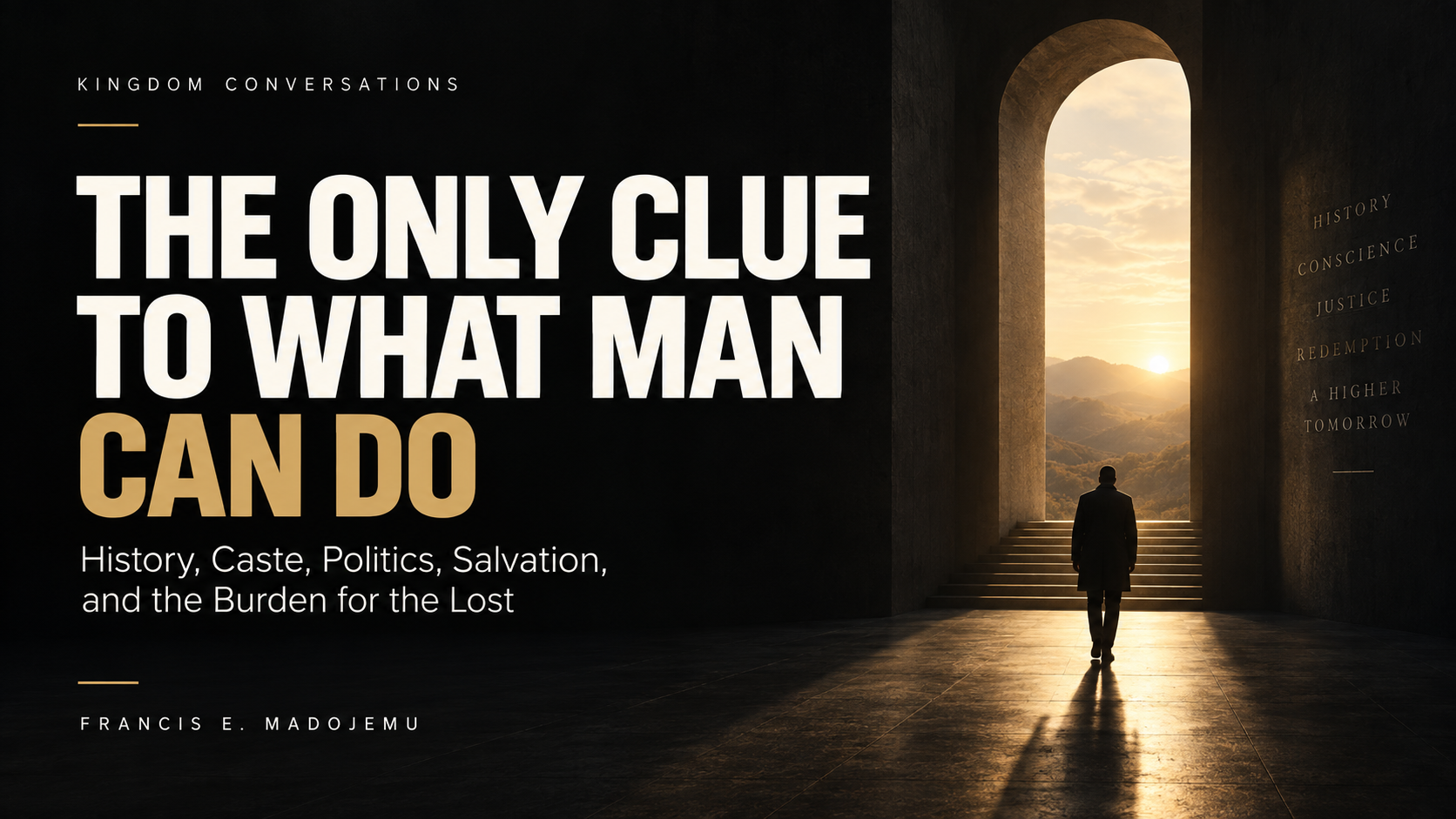
History, Caste, Politics, Salvation, and God’s Burden for the Lost
By Pastor Francis E. Madojemu
“The only clue to what man can do is what man has done.”
— R. G. Collingwood
There are sentences that do not merely inform us; they arrest us.
They stop us because they tell the truth without decoration. They remove the comfort of distance. They do not allow us to look at history as though it belongs only to other people, other nations, other centuries, or other monsters.
R. G. Collingwood’s statement is one of those sentences:
“The only clue to what man can do is what man has done.”
It is a terrible sentence because it is true.
If we want to know what human beings are capable of, we do not need to speculate. We need only look honestly at what human beings have already done.
Nuremberg tells us something about man. Rwanda tells us something about man. The Holocaust tells us something about man. American slavery tells us something about man. The caste system in India tells us something about man.
Lynching trees, slave ships, concentration camps, tribal massacres, segregated schools, propaganda radio, political extremism, and religious silence all testify to one sobering truth: the problem of mankind is deeper than politics, deeper than education, deeper than economics, deeper than leadership, and deeper than civilization itself.
All of these things matter. Politics matters. Education matters. Economics matter. Leadership matters. Culture matters. Law matters. Institutions matter.
But they are not the deepest root.
The biblical diagnosis is more searching: the only clue to what man can do is not only what man has done. It is what God has already revealed about the fallen human heart.
This is why the Church must recover God’s highest assignment: the salvation of mankind.
Not politics as ultimate. Not national development as ultimate. Not church programming as ultimate. Not influence as ultimate. Not success as ultimate. Not cultural sophistication as ultimate. Not even social reform as ultimate.
Salvation.
God’s great burden is that men and women should be saved, reconciled to Him, delivered from darkness, restored to truth, remade in Christ, and sent back into the world as witnesses, laborers, peacemakers, salt, and light.
Politics may shape the platform, but salvation is the mission.
Government may restrain evil, but government cannot regenerate the heart. Education may inform the mind, but education cannot redeem the soul. Law may punish crime, but law cannot produce love. Civilization may produce beauty, but civilization cannot cure sin.
This is why we must pray. This is why we must preach. This is why we must recover the burden for the lost. This is why we must ask the Lord of the harvest to send laborers.
History Is Not Merely Memory
History is not only the story of what happened. It is evidence of what can happen.
That is why Collingwood’s sentence is so unsettling. It removes our illusions about progress. It challenges the assumption that because we are modern, we are morally safer. It questions the belief that because we have universities, technology, institutions, media, diplomacy, and elections, we are immune from ancient evils.
The twentieth century should have permanently destroyed that illusion.
In an earlier presentation, Politics! Why We Must Pray & Participate, Charles Krauthammer’s warning is quoted powerfully: science, medicine, art, poetry, architecture, sports, and beautiful human pursuits may promise elegance and transcendence, but they can be subordinated to politics when politics goes wrong. The same presentation warns that if politics goes wrong, even an advanced culture can be swept away: “This is Germany 1933.”
That is not an abstract point.
A society may have universities and still produce concentration camps. A society may have doctors and still conduct experiments on human beings. A society may have lawyers and still legalize oppression. A society may have churches and still bless slavery. A society may have artists and still normalize cruelty. A society may have elections and still enthrone hatred. A society may have intelligence and still lack wisdom. A society may have culture and still lose conscience.
Germany 1933 was not merely a political failure. It was a spiritual, moral, cultural, intellectual, and anthropological collapse. Human beings were reclassified. Neighbors became threats. Citizens became contaminants. Jews became a “problem.” People made in the image of God were reduced to a category to be controlled, excluded, transported, and exterminated.
The Holocaust did not begin with gas chambers. It began with a lie about man.
The Hidden Architecture Beneath Visible Evil
This is where Isabel Wilkerson’s Caste: The Origins of Our Discontents becomes so important.
Wilkerson helps us see that visible eruptions of hatred are often supported by invisible systems of hierarchy. Her book examines what she calls an unspoken caste system: a hierarchy of human divisions that has shaped America and that she places in conversation with India and Nazi Germany.
That insight is crucial.
The visible thing may be racism. The invisible thing may be caste. The visible thing may be segregation. The invisible thing may be hierarchy. The visible thing may be genocide. The invisible thing may be dehumanization. The visible thing may be political violence. The invisible thing may be a corrupted doctrine of man. The visible thing may be tribal conflict. The invisible thing may be the belief that some lives matter less.
Wilkerson’s argument is not merely that people dislike one another. It is that societies build structures that assign value to people before they even speak, act, believe, or become known.
Caste says, “You are born into your place.” Caste says, “Your bloodline determines your worth.” Caste says, “Your appearance announces your rank.” Caste says, “Your group must remain beneath.” Caste says, “This hierarchy is natural.” Caste says, “This is the order of things.”
That is the genius and terror of caste: it hides evil inside normalcy.
People can participate in caste without thinking of themselves as hateful. They simply “know” who belongs where. They “know” who should lead. They “know” who should serve. They “know” whose pain matters. They “know” who should be feared. They “know” who should be doubted. They “know” who should be protected. They “know” who should be sacrificed.
Caste turns injustice into instinct. It makes inequality feel like order. It makes domination feel like tradition. It makes cruelty feel like necessity. It makes silence feel like wisdom.
And over generations, it can make the unthinkable feel normal.
American Slavery and the Nazi Imagination
One of the most sobering claims in Wilkerson’s book is that Nazi legal thinkers studied America’s racial laws while developing their own system of racial hierarchy.
This must be stated carefully.
America did not invent Nazi hatred. The Holocaust had its own European, German, ideological, antisemitic, political, and demonic history. But Wilkerson shows that in the early stages of the Third Reich, Nazi bureaucrats and legal scholars examined how the United States had used law to manage racial separation, racial purity, immigration restriction, and intermarriage.
That is a devastating connection.
It means one nation’s sin can become another nation’s study material. One society’s oppression can become another society’s precedent. One country’s caste logic can become another country’s legal experiment.
The Nazis looked at America and saw that a modern nation could speak the language of liberty while legally subordinating entire groups of human beings. They saw that law could be used to define, separate, restrict, stigmatize, and degrade.
That is why history is so dangerous when unredeemed man is reading it.
Man does not only commit evil. Man studies evil. Man borrows evil. Man improves evil. Man systematizes evil. Man legalizes evil. Man exports evil. Man imitates evil.
This is why Collingwood’s statement is not only philosophical. It is prophetic in its warning.
The lesson is not that some nations are uniquely evil while others are innocent. The lesson is that the fallen human heart, when given opportunity, ideology, grievance, power, and permission, can build systems that make evil appear righteous.
Scripture does not flatter man. Genesis shows that after the fall, brother kills brother. Babel shows organized human ambition without submission to God. Pharaoh shows state power turning people into forced labor. Haman shows political access married to ethnic hatred. Herod shows insecurity killing children. Pilate shows political convenience condemning innocence. The cross shows what the world does to perfect righteousness when power feels threatened by truth.
The Bible does not need Nuremberg to know what man can do. But Nuremberg reminds us that the Bible is right.
Caste Is a False Theology of Humanity
From a biblical perspective, caste is more than sociology. It is false theology.
It is a lie about creation. It is a lie about human worth. It is a lie about destiny. It is a lie about God.
It teaches that some people are created to be above and others beneath. It teaches that birth determines value. It teaches that certain bodies carry superiority and others carry shame. It teaches that a group may be treated as pollution. It teaches that the suffering of the lower-ranked can be justified by divine will, nature, karma, race, bloodline, history, tribe, or national necessity.
Wilkerson identifies the pillars that uphold caste systems, including divine will, heritability, endogamy, purity and pollution, occupational hierarchy, dehumanization, terror, and inherent superiority versus inferiority.
Biblically, each of these pillars is a rebellion against God’s truth.
Divine will misused is corrupted theology. People take the name of God and use it to bless hierarchy. They use sacred language to protect selfish power. They quote religion while violating the image of God in man.
Heritability is corrupted identity. It says your birth determines your worth. But the gospel says the deepest identity is not what you inherited from fallen human systems, but what God restores through new birth in Christ.
Endogamy is corrupted belonging. It polices love and family to keep groups from sharing destiny. It says, “Do not join them. Do not marry them. Do not become one with them. Do not let empathy cross the boundary.”
Purity and pollution is corrupted holiness. It treats certain people as contamination. But Jesus touched lepers, ate with sinners, crossed Samaritan boundaries, welcomed children, honored women, healed outsiders, and let the desperate come near.
Occupational hierarchy is corrupted vocation. It says some people are born only to serve the comfort of others. But Scripture gives dignity to work and insists that every person stands before God.
Dehumanization is corrupted anthropology. It removes people from the category of neighbor.
Terror as enforcement is corrupted authority. It uses fear to keep people “in their place.”
Inherent superiority and inferiority is corrupted worship. It enthrones one group’s pride and crushes another group’s dignity.
This is why caste is anti-gospel.
The gospel does not erase difference, but it destroys hierarchy of worth. Revelation does not show a redeemed humanity without tribe, tongue, people, and nation. It shows every tribe, tongue, people, and nation worshiping the Lamb.
Difference remains. Superiority dies.
The Image of God Is the Foundation
The biblical answer to caste begins in Genesis:
“Let Us make man in Our image, according to Our likeness.”
Before tribe, there is image. Before race, there is image. Before nationality, there is image. Before class, there is image. Before political citizenship, there is image. Before education, there is image. Before wealth, status, passport, title, complexion, language, or family name, there is image.
Every human being is made in the image of God.
That means no human being is disposable. No human being is vermin. No human being is pollution. No human being is merely labor. No human being is merely a voter. No human being is merely a consumer. No human being is merely a threat. No human being is merely a tribe. No human being is merely a caste. No human being is outside the moral concern of God.
Caste attacks this truth at the root. It says that the image of God is not enough. It says ancestry, blood, pigment, tribe, social rank, class, or inherited status must decide how much dignity a person deserves.
But Scripture says God made man in His image. The gospel says Christ died for the world. Pentecost says the Spirit speaks across languages. The Church says Jew and Gentile are reconciled in one body. The new creation says the Lamb redeems from every people.
So the Church must reject every system that trains us to see any human being as less than someone for whom Christ died.
Dehumanization Begins Before Violence
No genocide begins with killing. It begins with naming.
It begins with language. It begins with jokes. It begins with suspicion. It begins with categories. It begins with “those people.” It begins with contempt. It begins with false stories. It begins with propaganda. It begins with a wound that becomes an accusation. It begins with a group being blamed for the pain of another group.
Before the machete in Rwanda, there was language. Before the gas chamber in Nazi Germany, there was language. Before the slave ship, there was language. Before the lynching tree, there was language. Before discrimination becomes policy, it first becomes perception. Before people are killed, they are first lowered.
This is why the commandment of Jesus — “love your neighbor as yourself” — is not sentimental. It is civilization-saving.
When Jesus was asked, “Who is my neighbor?” He told the story of the Good Samaritan. That was not a harmless moral illustration. It was a direct assault on caste logic.
The priest passed by. The Levite passed by. The Samaritan came near.
The despised outsider became the example of mercy.
Jesus was teaching that neighborliness is not determined by tribe, religion, class, nationality, history, or inherited prejudice. Neighborliness is determined by mercy.
Caste asks, “Who is beneath me?” The gospel asks, “Who is wounded near me?” Caste asks, “Who belongs to my group?” The gospel asks, “Who needs mercy?” Caste asks, “Who must remain outside?” The gospel says, “Go into all the world.”
Caste builds walls. Christ breaks dividing walls. Caste produces suspicion. Christ produces reconciliation. Caste preserves rank. Christ creates one new humanity.
Rwanda, Nuremberg, and the Ordinary Person
This is what makes Rwanda and Nuremberg so terrifying.
They force us to confront the role of ordinary people in extraordinary evil.
It is comforting to imagine that atrocities are committed only by obviously deranged monsters. But that comfort is false. Systems of evil often depend on ordinary people doing ordinary things inside a corrupted moral order.
The clerk files the document. The teacher repeats the ideology. The broadcaster spreads the language. The pastor remains silent. The neighbor reports the neighbor. The judge applies the law. The officer follows the order. The crowd watches. The child learns. The citizen adjusts. The system continues.
This is why the question is not only, “Who gave the order?”
The deeper question is, “What kind of people had been formed to obey, approve, ignore, or benefit from the order?”
That is why the Church must care about formation.
Who is forming the conscience of the people? Who is teaching them what a human being is? Who is teaching them how to see the stranger? Who is teaching them how to treat the weak? Who is teaching them how to respond to difference? Who is teaching them what power is for? Who is teaching them whether truth matters? Who is teaching them whether God’s image is present in the enemy?
If the Church does not disciple people deeply, other systems will disciple them destructively.
Politics will disciple them. Media will disciple them. Tribe will disciple them. Class will disciple them. Fear will disciple them. Anger will disciple them. Algorithms will disciple them. Grievance will disciple them.
And eventually, people who attend worship services may still carry caste instincts into daily life.
Politics Matters, But Politics Cannot Save
This brings us back to politics.
We must not become simplistic. Politics matters.
The earlier presentation on politics rightly warns that politics has immense power. It can allow society to flourish when it is benign, and it can make everything around it wither when it becomes malign.
Politics can protect life. Politics can restrain violence. Politics can secure freedom. Politics can punish crime. Politics can protect worship. Politics can defend the vulnerable. Politics can organize justice. Politics can build systems.
Politics can also destroy. Politics can legalize oppression. Politics can empower hatred. Politics can turn lies into policy. Politics can weaponize identity. Politics can make cruelty respectable. Politics can use law to rank human beings. Politics can make evil efficient.
This is why Christians must pray and participate.
But the companion presentation gives the correction we must never lose: politics cannot substitute for spiritual awakening. Leadership is important, and government is ordained by God, but even competent government does not possess the deepest tools necessary to restore a nation to true health.
This is the central balance.
If we ignore politics, we abandon a platform that affects real human lives. If we idolize politics, we ask Caesar to do what only Christ can do. If we withdraw from politics, we may leave the vulnerable undefended. If we worship politics, we may become blind to our own compromise.
So we must pray. We must participate. We must speak truth. We must seek justice. We must train leaders. We must build institutions. We must care about policy.
But we must never confuse political victory with salvation.
A law can restrain murder, but it cannot make a man love his brother. A constitution can define rights, but it cannot produce righteousness. An election can change officeholders, but it cannot cleanse the heart. A government can build schools, but it cannot guarantee wisdom. A court can punish injustice, but it cannot create mercy. A president can lead a nation, but he cannot become the mediator between God and man.
There is one Mediator. His name is Jesus Christ.
1 Timothy 2 Gives the Order
The biblical order is found in 1 Timothy 2.
Paul tells the Church to make supplications, prayers, intercessions, and thanksgiving for all men — including kings and those in authority — so that we may live quiet and peaceable lives in all godliness and reverence. Then Paul immediately says that this is good and acceptable before God our Savior, who desires all men to be saved and to come to the knowledge of the truth.
That passage gives us the proper sequence.
We pray for leaders. We pray for peace. We pray for order. We pray for godliness. We pray for conditions in which the gospel may move freely.
But the destination is not merely political stability. The destination is salvation.
God desires all men to be saved and come to the knowledge of the truth.
So prayer for government is not a replacement for evangelism. It is part of the environment in which evangelism can flourish.
Prayer for peace is not merely so that believers can be comfortable. It is so that the mission of God can advance. Prayer for kings is not political idolatry. It is kingdom obedience.
We pray for rulers because their decisions affect the conditions under which people live, worship, hear truth, raise families, build communities, and encounter the gospel.
But we do not make rulers saviors.
Politics is the platform. Salvation is the purpose. Government is important. Christ is ultimate.
The Real Problem Is Sin
The presentation Politics Can’t Substitute for Spiritual Awakening states the deeper diagnosis: the real problem runs much deeper than inadequate political leadership; it flows from sin nature. Apart from Christ’s redemptive work, people inevitably live for themselves, and the nation becomes worse for it.
This is not merely an American issue. It is a human issue.
The problem is not only that we have bad leaders. Bad leaders came from somewhere.
They came from families. They came from schools. They came from churches, mosques, communities, professions, political parties, business networks, and social systems.
They were shaped by values. They were discipled by desires. They were rewarded by systems. They were normalized by culture. They were protected by silence.
A selfish people will eventually produce selfish politics. A corrupt people will eventually produce corrupt institutions. A tribal people will eventually produce tribal governance. A greedy people will eventually produce predatory economics. A fearful people will eventually empower dangerous saviors. A spiritually asleep church will eventually lose its prophetic function.
So the solution cannot merely be, “replace the people in power,” although leadership change may sometimes be necessary.
The deeper need is transformation.
As the second presentation says, a more permanent change requires transformation of hearts and lives by the power of the gospel. Only through revival of the church and spiritual awakening among the lost can true selfless love for neighbor bring health back to a nation.
Politics can rearrange the furniture. The gospel rebuilds the house. Politics can change the rules. The gospel changes the ruler of the heart. Politics can restrain behavior. The gospel transforms desire. Politics can punish hatred. The gospel produces love. Politics can manage the symptoms. The gospel confronts the disease.
Why This Matters for Nigeria and Africa
We must not read Caste only as an American book. We must not read Nuremberg only as a German warning. We must not read Rwanda only as a Rwandan tragedy. We must not read slavery only as Western history.
These are human warnings.
Caste thinking appears wherever people are ranked as more or less human.
In Nigeria and Africa, caste may not always use the language of Black and white. It may appear as tribe, ethnicity, region, religion, class, education, wealth, family name, denomination, gender, age, accent, political affiliation, or proximity to power.
We know the language: “our people,” “those people,” “that tribe,” “these Northerners,” “these Southerners,” “these Muslims,” “these Christians,” “these villagers,” “these elites,” “these settlers,” “these indigenes,” “these outsiders,” “these poor people,” “these uneducated people,” “they are not like us.”
That is where danger begins.
A society does not become violent all at once. It first becomes careless with language. Then careless with truth. Then careless with justice. Then careless with life.
The Church in Nigeria must therefore teach a biblical doctrine of man with courage and clarity.
The image of God is greater than tribe. The blood of Christ is greater than bloodline. The kingdom of God is greater than political party. Truth is greater than propaganda. Justice is greater than group loyalty. Mercy is greater than revenge. The gospel is greater than ethnic memory.
This does not make us naive. It makes us biblical.
We are not called to pretend that history, pain, injustice, and group conflict do not exist. We are called to bring them under the Lordship of Christ.
The Church must become a people who refuse dehumanization at every level.
The Church Must Not Be Silent
Silence is one of the ways evil matures.
Silence tells the victim, “You are alone.” Silence tells the oppressor, “Continue.” Silence tells the crowd, “This is normal.” Silence tells the next generation, “There is nothing to confess.” Silence tells the Church, “Stay safe.”
But the Church cannot be silent where the image of God is being denied. The Church cannot be silent about sin. The Church cannot be silent about salvation. The Church cannot be silent about hatred. The Church cannot be silent about tribal contempt. The Church cannot be silent about injustice. The Church cannot be silent about the lost.
Yet our speech must be gospel-shaped.
We are not called merely to shout at darkness. We are called to bear witness to light. We are not called merely to condemn evil systems. We are called to make disciples who can enter systems with truth, courage, mercy, holiness, wisdom, and love. We are not called merely to win arguments. We are called to rescue souls.
The Lost Are God’s Burden
This is where we must return.
If man’s deepest problem is sin, then God’s deepest remedy is salvation. If human systems are corrupted by fallen hearts, then God must create new hearts. If caste is a false doctrine of humanity, then the gospel is God’s true doctrine of humanity redeemed in Christ.
This is why the Church must never lose the burden for the lost.
We can build institutions and forget souls. We can run programs and forget souls. We can hold conferences and forget souls. We can discuss politics and forget souls. We can host anniversaries and forget souls. We can become culturally sophisticated and forget souls. We can become activists and forget souls. We can become respectable and forget souls. We can even become church-centered and forget Christ’s mission.
But Jesus said the Son of Man came to seek and to save that which was lost.
The lost are not an item on the church’s agenda. The lost are the reason the Church remains on earth.
The Church is not merely a worship center, teaching center, event center, or community center. The Church is a witness-bearing, disciple-making, interceding, laborer-sending body under the Lordship of Jesus Christ.
Our politics must serve that. Our buildings must serve that. Our anniversary must serve that. Our prayers must serve that. Our programs must serve that. Our influence must serve that. Our resources must serve that. Our platforms must serve that.
The Lost and the Laborers
When Jesus saw the crowds, He was moved with compassion because they were harassed and helpless, like sheep without a shepherd.
Then He said:
“The harvest truly is plentiful, but the laborers are few. Therefore pray the Lord of the harvest to send out laborers into His harvest.”
That is the assignment.
The world does not merely need commentators. The world needs laborers. The nation does not merely need critics. The nation needs laborers. The Church does not merely need attenders. The Church needs laborers. Politics does not merely need voters. Politics needs redeemed laborers. Media does not merely need platforms. Media needs truth-bearing laborers. Business does not merely need entrepreneurs. Business needs righteous laborers. Education does not merely need teachers. Education needs formation-minded laborers. Families do not merely need income. Families need spiritually awake laborers.
This is why Saturday prayer for the lost and laborers is not a side activity. It is not a religious routine. It is not a small program. It is a recovery of God’s burden.
The prayer is simple but massive:
Lord, save the lost.
Lord, send laborers.
Not laborers who seek power for themselves. Not laborers who baptize tribal hatred. Not laborers who use ministry for status. Not laborers who replace the gospel with politics. Not laborers who become silent before injustice. Not laborers who carry caste instincts into Christian language.
But laborers who carry the heart of Christ into every system of life.
Saturday Prayer as National and Spiritual Work
Those who pray for revival and spiritual awakening are not escaping reality. They are engaging the deepest reality.
The OneCry presentation says those who are praying and working for revival and spiritual awakening in their communities are engaging in the most critically essential activity possible.
That is not an exaggeration when properly understood.
Prayer for the lost is not less practical than politics. It is more foundational. Prayer for laborers is not less urgent than policy. It is more generative. Prayer for awakening is not less important than elections. It reaches the place elections cannot reach.
This does not mean we stop participating publicly. It means our participation must be fueled by a deeper altar.
Saturday prayer should therefore become a weekly recovery of God’s priority.
We pray because God desires all men to be saved. We pray because history has shown what man can do without God. We pray because caste has shown how societies organize human hierarchy. We pray because politics cannot regenerate the heart. We pray because the harvest is plentiful. We pray because laborers are few. We pray because Nigeria needs more than outrage. We pray because the Church must awaken. We pray because souls are eternal. We pray because Christ died. We pray because the Spirit has been given. We pray because the Church has been sent.
What We Must Pray
We must pray first with thanksgiving. We thank God that He did not abandon humanity to sin. We thank Him for Christ, for the cross, for mercy, for the gospel, for the Spirit, for the Church, for the privilege of witness.
We must pray with repentance. We confess that we have often cared more about comfort than souls. We have cared more about events than evangelism. We have cared more about politics than prayer. We have cared more about attendance than transformation. We have cared more about church activity than the salvation of men.
We must pray for the lost. We ask God to convict, draw, awaken, interrupt, reveal Christ, open blind eyes, soften hard hearts, break deception, and bring men and women to the knowledge of the truth.
We must pray for laborers. We ask God to raise witnesses, intercessors, evangelists, disciplers, teachers, shepherds, reformers, builders, fathers, mothers, marketplace ministers, public servants, media voices, and ordinary believers who carry extraordinary burden.
We must pray for leaders. We pray for kings and all in authority — not because they are saviors, but because their decisions affect peace, justice, freedom, godliness, and gospel access.
We must pray against dehumanization. We resist tribal hatred, class contempt, religious arrogance, political idolatry, ethnic superiority, propaganda, bitterness, vengeance, and every caste instinct that contradicts the image of God.
We must pray for the Church. We ask God to make us salt and light again. Not merely a crowd. Not merely an institution. Not merely an event center. A living body carrying the burden of Christ.
Build Again + Better
This also connects to our anniversary burden: Build Again + Better.
If we are building again, we must ask what we are rebuilding for.
Not merely better events. Not merely better branding. Not merely better facilities. Not merely better programs. Not merely better administration. Not merely better services. Not merely better public image.
We are rebuilding so that the Church can carry God’s burden again.
One of the wells we must reopen is the well of evangelism. One of the gates we must rebuild is the gate of intercession. One of the systems we must restore is the system that keeps salvation central. One of the burdens we must recover is the burden for the lost.
A church can become sophisticated and forget souls. A church can become busy and forget souls. A church can become influential and forget souls. A church can become respected and forget souls. But a church that forgets the lost has forgotten why Jesus came.
So Build Again + Better must include: build prayer again; build evangelism again; build discipleship again; build compassion again; build courage again; build public witness again; build gospel-centered engagement again; build a people who can enter politics without worshiping politics; build a people who can study history without despairing; build a people who can confront caste without hatred; build a people who can serve the nation without losing the gospel.
What History Reveals, Christ Redeems
History shows us what man can do. Caste shows us how man organizes it. Politics shows us how man legalizes or restrains it. But Scripture shows us why man needs salvation. And Christ shows us God’s answer.
The answer to Nuremberg is not merely better trials. The answer to Rwanda is not merely better peacekeeping. The answer to slavery is not merely better laws. The answer to caste is not merely better sociology. The answer to political failure is not merely better candidates.
All these matter, but they are not enough.
The deepest answer is a new humanity in Christ.
A people born again. A people reconciled to God. A people delivered from hatred. A people who refuse to rank what God has made in His image. A people who pray for kings but worship only God. A people who participate in politics but preach salvation. A people who enter systems but are not captured by systems. A people who see the lost not as enemies, statistics, voters, consumers, or outsiders, but as souls for whom Christ died.
That is the assignment.
The only clue to what man can do is what man has done. But the greatest clue to what God can do is what God has done in Christ.
He has entered history. He has borne sin. He has broken dividing walls. He has conquered death. He has opened the way of salvation. He has sent His Spirit. He has commissioned His Church.
Now we must pray. Now we must preach. Now we must go. Now we must ask the Lord of the harvest to send laborers.
Because politics may shape the platform, but salvation is the mission.
And until the lost are saved, the deepest work remains unfinished.
Blog Publishing Notes
Suggested excerpt:
History shows what man can do. Caste shows how man organizes it. Politics shows how man legalizes or restrains it. But Scripture shows why man needs salvation, and Christ shows God’s answer.
Suggested slug:the-only-clue-to-what-man-can-do
Suggested categories:
Faith and Public Life; Prayer; Nation Building; Salvation; Theology and Culture
Suggested tags:
salvation, politics, caste, Rwanda, Nuremberg, slavery, image of God, laborers, prayer, spiritual awakening
Sources and Attribution Links
Isabel Wilkerson, Caste: The Origins of Our Discontents
https://www.penguinrandomhouse.com/books/653196/caste-by-isabel-wilkerson/
Stephen Kinzer, A Thousand Hills
https://stephenkinzer.com/2013/09/a-thousand-hills-rwandas-rebirth-and-the-man-who-dreamed-it/
Charles Krauthammer, Things That Matter / politics excerpts
https://www.washingtonpost.com/graphics/2018/opinions/charles-krauthammer-columns/
R. G. Collingwood, The Idea of History
https://books.google.com/books/about/The_Idea_of_History.html?id=168kAQAAMAAJ
OneCry source link shown in the original presentation
https://www.onecry.com/blog/personal-revival/making-america-great-again
The Gospel Coalition review noting the Collingwood quote in Nuremberg
https://www.thegospelcoalition.org/article/nuremberg-christian-movie-review/
United States Holocaust Memorial Museum, Rwanda genocide overview
https://encyclopedia.ushmm.org/content/en/article/the-rwanda-genocide


