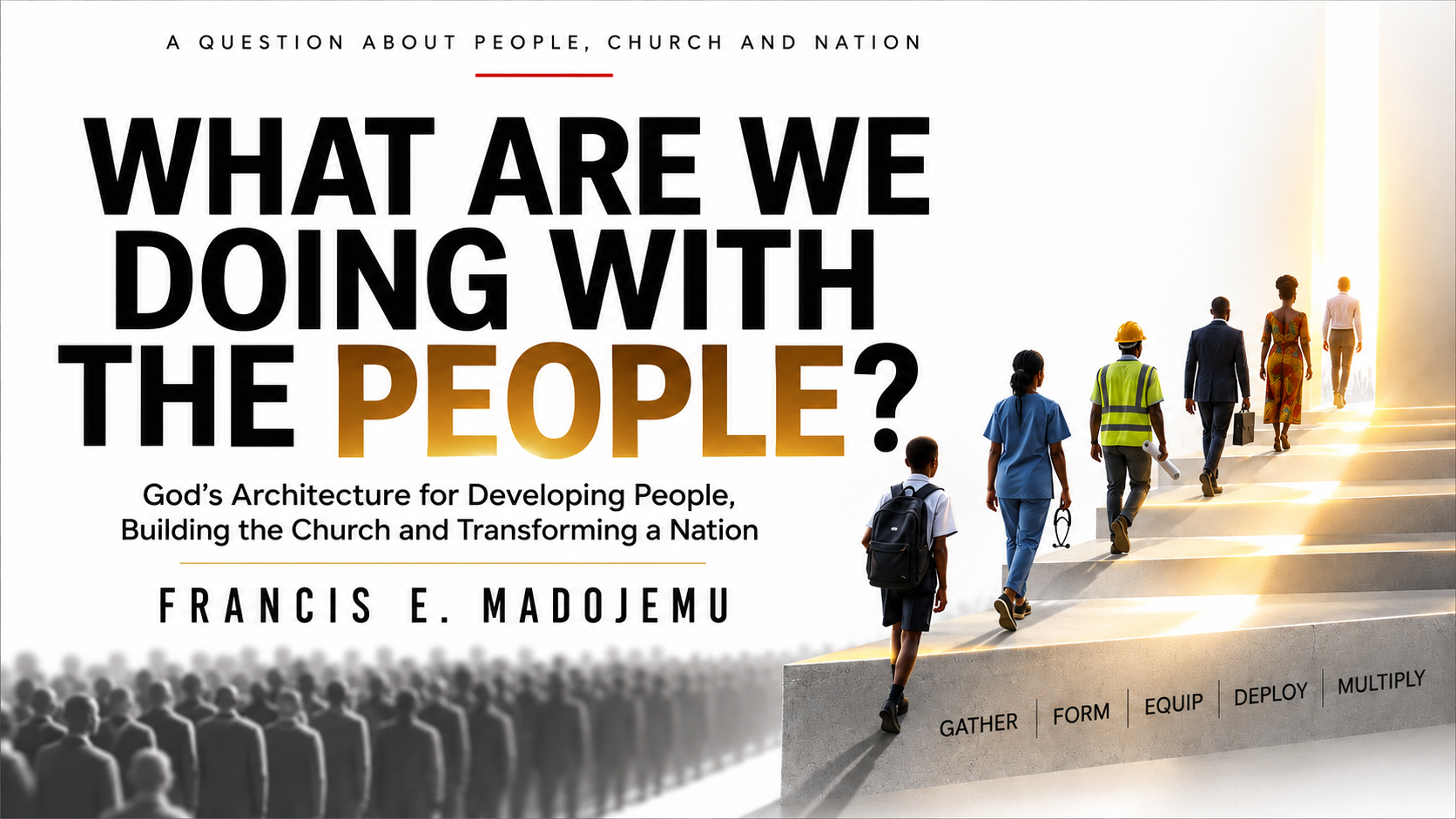
Perhaps the greatest resource of a nation is not what lies beneath its ground, but the people walking on top of it.
By Francis E. Madojemu
A few days ago, I listened to Botswana’s President Duma Boko speak about Africa’s extraordinary natural resources.
His argument was compelling.
Africa possesses enormous mineral wealth.
Cobalt. Lithium. Copper. Gold. Oil. Gas. Vast agricultural potential. A young population. Enormous markets.
And yet much of the continent remains poor.
It is one of the great contradictions of our time.
But as I listened, another question began troubling me:
What exactly makes a country rich?
Because if natural resources make countries rich, we have a problem explaining Singapore.
Singapore does not possess anything remotely comparable to the natural-resource endowment of Nigeria or many other African countries.
Yet Singapore is rich.
Nigeria possesses enormous resources.
Yet millions of Nigerians remain poor.
Something does not fit.
Perhaps we have confused resources with wealth.
They are not the same thing.
An oil deposit does nothing by itself.
Someone must discover it, finance its extraction, engineer the wells, transport it, refine it, manufacture with it, market its products and build institutions capable of governing the entire process.
Lithium does not manufacture a battery.
Cobalt does not build an electric vehicle.
Land does not grow food by itself.
Gold does not establish a financial system.
Resources are potential.
People convert potential into value.
And that led me to a proposition that became increasingly difficult to escape:
THE GREATEST RESOURCE OF A NATION IS ITS PEOPLE.
Not because natural resources are unimportant.
They are enormously important.
But because virtually every other resource depends upon human beings to recognise it, develop it, steward it and convert it into value.
The book eventually calls this People Capital.
But even that expression requires care.
People are not machines.
They are not simply economic units whose purpose is to increase GDP.
The biblical account begins somewhere much deeper:
“And God said, Let us make man in our image, after our likeness…”
— Genesis 1:26, KJV
Before economics, there is dignity.
Then comes responsibility.
God places Adam in the garden “to dress it and to keep it.”
The garden contains resources.
But Adam receives responsibility.
Or, as I eventually put it in the book:
GOD PUTS RESOURCES IN THE EARTH, BUT HE PUTS RESPONSIBILITY IN PEOPLE.
That changes the development conversation.
The real question is no longer simply:
What does a country have?
It becomes:
What can its people do with what it has?
PERHAPS AFRICA HAS A CONVERSION PROBLEM
Africa is not poor in potential.
Our difficulty may be that we have repeatedly failed to build the people and systems capable of converting potential into widespread prosperity.
Land must become food.
Minerals must become industry.
Oil must become energy, petrochemicals and manufacturing.
Knowledge must become productive capability.
Population must become People Capital.
And that last conversion is perhaps the most important.
A population of 200 million people is not automatically an economic advantage.
Neither, incidentally, is a church of 20,000 people automatically evidence of transformed human beings.
Numbers are not capability.
Singapore’s experience is instructive precisely because it could not rely on abundant natural resources. Its people had to become extraordinarily important to its survival.
Education mattered.
Technical skills mattered.
Administrative competence mattered.
Infrastructure mattered.
Institutions mattered.
Continuous learning mattered.
The people themselves became part of the country’s productive infrastructure.
And somewhere in thinking about that, an uncomfortable question occurred to me.
If this principle is true of countries—
isn’t it also true of churches?
WHAT IS THE GREATEST RESOURCE IN OUR CHURCHES?
Buildings?
Land?
LED screens?
Cameras?
Sound systems?
Money?
Programmes?
Social-media reach?
I believe in excellence.
Church buildings should be good. Technology should be used well. Children’s environments should be excellent. Administration matters. Sound matters. Lighting matters.
And church growth matters.
This is not an argument against large churches.
Acts celebrates numerical growth.
Three thousand people were added in one day.
Churches “increased in number daily.”
So I have no interest in creating a theology in which small is automatically spiritual and large is automatically suspicious.
Gideon’s 300 teaches us that God is not constrained by numbers.
Acts teaches us that God is not offended by numbers.
Therefore:
SMALLNESS IS NOT THE GOAL.
BIGNESS IS NOT THE GOAL.
FRUITFULNESS IS THE GOAL.
And that produces a much more demanding question.
If God gives us 300 people:
What are we doing with the 300?
If He gives us 3,000:
What are we doing with the 3,000?
If He gives us 30,000:
What are we doing with the 30,000?
The larger the harvest, perhaps the greater the stewardship.
Because people are not attendance statistics.
People carry intelligence.
Gifts.
Experience.
Creativity.
Relationships.
Pain.
History.
Calling.
Ideas.
Possibility.
And above all, the image of God.
So what are those people becoming?
USING PEOPLE IS NOT THE SAME AS DEVELOPING PEOPLE
This became one of the most uncomfortable distinctions in the book.
Churches can become extremely efficient at using people’s existing abilities.
You can sing?
Join the choir.
You understand cameras?
Join Media.
You understand money?
Join Finance.
You organise well?
Join Administration.
There is nothing wrong with any of these things. Service itself is part of discipleship.
But there is another question.
Ten years later, what happened to the person carrying the gift?
Is the singer wiser?
Is the cameraman more capable?
Is the accountant more trustworthy?
Is the administrator a stronger leader?
Are they better at relationships?
Better at work?
Better with money?
Better parents?
Better spouses?
More disciplined?
More responsible?
More aware of their purpose?
More capable of developing somebody else?
It is entirely possible for an organisation to benefit from someone’s capacity for ten years without significantly increasing that capacity.
That should trouble us.
The question cannot only be:
How can this person help the Church?
It should also be:
WHAT HAS GOD PUT INSIDE THIS PERSON — AND HOW DO WE HELP IT DEVELOP?
The young woman entering university may not merely be another member of the youth ministry.
She may be a future scientist.
The young man operating a church camera may not merely be useful to Media.
He may be a future filmmaker.
The accountant may not simply be somebody who can count the offering.
She may be someone God intends to influence financial integrity in corporations.
The businessman should not primarily become interesting to the Church because he can give money.
Perhaps his business itself is ministry: creating employment, solving problems, treating people justly and modelling righteous enterprise.
The teacher may be shaping generations.
The public servant may be stewarding institutions.
The politician’s vocation itself may be sacred responsibility.
If that is true, church changes.
We stop merely asking people to come in and help us build the institution.
We begin equipping them to go out and serve God’s purposes in the world.
This is exactly where Ephesians 4 becomes revolutionary.
Christ gives apostles, prophets, evangelists, pastors and teachers:
“For the perfecting of the saints, for the work of the ministry…”
The ministry gifts develop the people.
The people do the work.
And much of that work happens outside the church building.
The Church is not supposed merely to gather Christians.
It is supposed to form people.
GOD DOES NOT ONLY USE PEOPLE. HE BUILDS THEM.
As I followed the argument further into Scripture, something became increasingly obvious.
We often meet biblical people at the point of their usefulness and forget their development.
We meet Moses confronting Pharaoh.
But Moses had a process.
We meet Joshua commanding Israel.
But Joshua had spent years beside Moses.
We meet David as king.
But there was a field, sheep, a lion, a bear, Goliath, Saul’s court, warfare, caves and years of formation before the throne.
Joseph had dreams.
But between the dream and government came betrayal, slavery, service, temptation, prison, administration and responsibility.
Daniel possessed spiritual understanding, but Scripture also says God gave him and his companions:
knowledge and skill in all learning and wisdom.
And when Nebuchadnezzar examined them, he found them exceptionally capable.
Bezalel was filled with the Spirit of God—and that filling expressed itself through wisdom, understanding, knowledge and craftsmanship.
God does not appear embarrassed by skill.
He develops it.
One verse eventually became almost a summary of the architecture:
“So he fed them according to the integrity of his heart; and guided them by the skilfulness of his hands.”
— Psalm 78:72, KJV
Integrity of heart.
Skilfulness of hands.
Character and capability.
We need both.
Character without capability may be sincere but ineffective.
Capability without character may become dangerous.
A corrupt incompetent person can cause damage.
A corrupt highly competent person can cause much greater damage.
So People Capital cannot simply mean producing cleverer, richer or more technically capable human beings.
It must ask:
Who are these people becoming?
PERHAPS THIS IS WHY RIGHTEOUSNESS EXALTS A NATION
This is where the biblical and national-development arguments begin to meet.
“Righteousness exalteth a nation: but sin is a reproach to any people.”
— Proverbs 14:34, KJV
We often treat that as a purely spiritual statement.
But righteousness has social consequences.
Truthfulness matters economically.
Trust matters economically.
Justice matters economically.
Keeping agreements matters economically.
Responsible government matters economically.
Honest accounting matters economically.
Good stewardship matters economically.
Think about the cost of a low-trust society.
More security.
More verification.
More monitoring.
More enforcement.
More contracts.
More suspicion.
More friction.
Corruption is not merely a moral problem.
It destroys value.
So capability matters.
But character directs capability.
That produces one of the book’s central formulations:
RESOURCES + PEOPLE + SYSTEMS = PROSPERITY POTENTIAL.
But even that is not enough.
Because capable people can build evil systems.
Therefore:
RIGHTEOUSNESS DETERMINES HOW PROSPERITY IS CREATED, USED AND DISTRIBUTED.
The Church therefore has a contribution to national development that neither government nor markets can completely replace.
Government can build infrastructure.
Schools can teach mathematics.
Industry can teach engineering.
Markets can allocate capital.
But somebody must still ask:
What is good?
What is just?
What is enough?
What is stewardship?
What is human dignity?
For whom is our prosperity?
What kind of person should possess power?
The Church’s contribution includes helping form the moral architecture inside the people operating the systems.
BUT FORMATION CANNOT BE AN ACCIDENT
This was where the book became practical.
If we say the Church should develop people, what exactly do we mean?
Eventually the architecture became something like this:
TRUTH — What must the person know and believe?
CHARACTER — Who must the person become?
CAPABILITY — What must the person learn to do?
PRACTICE — Where will they exercise it?
FEEDBACK — How will they discover what needs improvement?
RESPONSIBILITY — What can increasingly be entrusted to them?
MULTIPLICATION — Who will they eventually develop?
And over all seven questions sits another:
FOR WHAT?
Why are we developing people?
Not so that they become more useful to our organisation.
That is manipulation.
We develop people so they can become faithful stewards of what God has entrusted to them.
The person is not our product.
The Church does not own the outcome.
Different gifts.
Different personalities.
Different vocations.
Different assignments.
The objective is maturity, not cloning.
And Ephesians 4 ends not with a factory producing identical people, but with a body in which every part supplies something.
THEN WE MUST CHANGE WHAT WE COUNT
This raises another uncomfortable question for churches.
What do we measure?
Attendance?
Offerings?
Buildings?
Branches?
Followers?
Views?
All useful.
But insufficient.
Because whatever an organisation continually measures, celebrates and promotes eventually shapes its culture.
Suppose we also began asking:
Are people growing in character?
Are marriages becoming healthier?
Are parents becoming more intentional?
Are young people discovering vocation?
Are workers becoming more capable?
Are entrepreneurs creating value?
Are people learning stewardship?
Are leaders developing other leaders?
Are members solving problems in their communities?
Are people becoming more trustworthy?
Is somebody more useful to the world because they spent ten years among us?
Then perhaps we would develop a very different understanding of church success.
THIS IS ALSO AN EDUCATION QUESTION
The argument cannot remain inside the Church.
Nigeria has millions of people already learning every day.
In workshops.
Markets.
Shops.
Farms.
Studios.
Kitchens.
Building sites.
Mechanic villages.
Tailoring shops.
Beauty salons.
Informal apprenticeships.
People are learning.
The question is whether those learning systems can become better.
This matters because education cannot merely mean spending years in a classroom.
A certificate is evidence that someone completed a programme.
It is not necessarily evidence that someone can solve a problem.
The real question is:
What can you now do that you could not do before?
Education should increase capability.
This does not diminish universities or formal education.
It makes their purpose more demanding.
And it forces us to recognise and improve the enormous learning infrastructure that already exists outside formal institutions.
Perhaps Africa does not need only more classrooms.
Perhaps we need more effective formation and capability systems everywhere people already learn.
GOOD PEOPLE ALSO NEED GOOD SYSTEMS
But the book eventually had to correct itself.
It is too simple merely to say:
Develop people and everything will work.
Capable people can be trapped inside dysfunctional systems.
A brilliant entrepreneur cannot overcome every infrastructure failure.
A competent public servant can be constrained by a corrupt institution.
A skilled manufacturer still needs electricity, logistics, finance and functioning markets.
A talented young person needs opportunity.
So the argument matures.
Natural resources alone are insufficient.
People alone are insufficient.
Systems alone are insufficient.
Prosperity emerges when capable people operate through effective systems to convert available resources into useful value.
And character determines what those people and systems ultimately serve.
That is why this is simultaneously a conversation about:
education,
church,
government,
business,
family,
institutions,
technology,
and national development.
They meet inside the human being.
AND THEN THE QUESTION TURNED ON ME
This may have been the most difficult part of writing the book.
It is easy to ask:
What is government doing with the people?
It is harder for a pastor to ask:
What have I done with the people God entrusted to me?
The Bridge Network City Church turns twenty on 1 October 2026.
Anniversaries invite celebration.
But I have found myself asking another question:
What exactly have these twenty years been building?
Years ago, in the original vision of The Bridge Network, we described the Church as:
“the training ground for people who will impact the society around them.”
I had almost forgotten how explicitly we said it.
Twenty years later, that sentence returned to confront me.
Did we believe it?
Yes.
But did we fully build it?
That is a different question.
There comes a point when conviction must become architecture.
A sermon must become a practice.
A vision must become a system.
And belief must eventually answer:
WHAT DID YOU BUILD BECAUSE YOU BELIEVED IT?
For me, therefore, this book is not primarily criticism of government, education or even the Church.
It is a reckoning with stewardship.
I cannot develop 200 million Nigerians.
But I can take responsibility for the people within my reach.
And perhaps transformation always begins somewhere that small.
START WITH TWENTY
One temptation with ideas about Africa is to make them enormous immediately.
A conference.
A foundation.
A national programme.
A movement.
Perhaps not.
Perhaps we should begin with twenty people.
One cohort.
One problem.
One experiment.
Teach.
Train.
Practise.
Measure.
Learn.
Improve.
Repeat.
If it fails, learn from it.
If it works, improve it.
Then scale.
Evidence before expansion.
That startup mentality increasingly influences how I think about BridgeWorks and People Capital.
Start small enough to learn.
Think long enough to matter.
We do not need another impressive programme that produces photographs and reports but changes little.
The dream is not another programme.
The dream is a culture.
A culture in which the question becomes instinctive.
A teenager arrives:
What are we doing with this teenager?
A young employee joins:
What are we doing with this person’s potential?
A child enters school:
What are we doing with this child?
A gifted person enters church:
What are we doing with this gift?
A country has millions of young people:
What are we doing with them?
And the answer must never simply be:
Using them.
The answer should increasingly be:
WE ARE HELPING THEM BECOME.
Faithful.
Wise.
Skilled.
Loving.
Productive.
Righteous.
Responsible.
Useful.
Capable of developing others.
That is People Capital in Kingdom language.
Not extracting maximum productivity from human beings.
But stewarding human possibility under God.
THEN THERE IS ONE PERSON LEFT
There is a danger in everything I have written so far.
You can read it and immediately produce a list of institutions that have failed you.
Government should have developed me.
My school should have trained me.
My pastor should have equipped me.
My parents should have prepared me.
My employer should invest in me.
The system should create opportunity.
Much of that may be true.
But eventually the question turns.
From:
What are THEY doing with the people?
to:
What are WE doing with the people?
and finally:
WHAT AM I DOING WITH ME?
Because no government, church, parent, mentor, teacher or employer can fully develop a person who refuses to grow.
God works in us.
But we respond.
Grace is not passivity.
We learn.
Study.
Practise.
Ask.
Seek.
Work.
Obey.
Try.
Fail.
Reflect.
Improve.
Grow.
Perhaps every person needs a simple development plan:
What is God forming in me?
Character.
What do I need to know?
Knowledge.
What do I need to learn to do?
Skill.
What responsibility should I carry next?
Practice.
Who am I developing?
Multiplication.
And perhaps one more question sits above all of them:
Why?
If development is merely about becoming superior to other people, something has gone wrong.
If it is about serving better, stewarding better and becoming more faithful to our assignment, we are closer.
God does not only ask:
What can you do?
He also asks:
WHO ARE YOU BECOMING WHILE YOU DO IT?
PERHAPS THIS IS HOW NATIONS CHANGE
Not only through one president.
Not only through one election.
Not only through one revival.
Not only through one economic policy.
But through millions of people becoming:
more truthful,
more capable,
more responsible,
more productive,
more skilled,
more loving,
more trustworthy,
more useful—
and then building systems that preserve and multiply those qualities.
Perhaps this is how a church changes a city.
Not because everybody in the city attends our programme.
But because the people who encounter Christ among us become different and carry that difference into ordinary life.
Better teachers.
Better employers.
Better parents.
Better craftsmen.
Better professionals.
Better public servants.
Better citizens.
Better leaders.
That is impact.
And perhaps this is how righteousness exalts a nation:
righteous choices made by formed people inside increasingly righteous systems.
THE QUESTION IS NOW EVERYWHERE
To government:
What are you doing with the people?
To education:
What are you doing with the people?
To business:
What are you doing with the people?
To parents:
What are you doing with the people?
To pastors:
What are you doing with the people?
To the Church:
WHAT ARE WE DOING WITH THE PEOPLE?
And to every one of us:
What are you doing with the person God has given you to steward—yourself?
The size of the responsibility differs.
The stewardship does not.
Three hundred people.
Thirty thousand people.
Two hundred million people.
One person.
The question remains:
WHAT BECAME OF THEM?
THIS QUESTION HAS NOW BECOME A BOOK
What began for me as a response to an argument about Africa’s natural resources became something much larger.
Singapore entered the conversation.
Then education.
Then the Church.
Then Gideon’s 300.
Moses.
Joseph.
Bezalel.
David.
Daniel.
Jesus and the disciples.
Ephesians 4.
Righteousness.
People Capital.
Nigeria’s informal learning systems.
Institutions.
BridgeWorks.
The original vision of The Bridge Network.
Twenty years of ministry.
And eventually, myself.
I began to realise that perhaps I had been writing this book, in fragments, for nearly twenty years.
The result is:
WHAT ARE WE DOING WITH THE PEOPLE?
God’s Architecture for Developing People, Building the Church and Transforming a Nation
It is being published in the twentieth-anniversary year of The Bridge Network City Church.
But before the final public release, I would like a small group of people to read a preview copy.
Not simply to praise it.
I want people willing to think with it.
Pastors.
Educators.
Entrepreneurs.
Public servants.
Parents.
Policy thinkers.
Young leaders.
People interested in Africa, human development, discipleship, education, enterprise and national transformation.
If this question resonates with you and you would like to read the preview edition, send me a direct message with the words:
PEOPLE PREVIEW
I will send details on how to receive a copy.
And when you have read it, I would particularly value your response to three questions:
What challenged you?
What do you disagree with?
What should we build because this is true?
Because I increasingly believe the last question is the most important.
We have had enough ideas that ended as ideas.
The question now is not simply:
Do we believe this?
It is:
WHAT WILL WE BUILD BECAUSE WE BELIEVE IT?
Francis E. Madojemu
ADDENDUM
PEOPLE CAPITAL, PRODUCTIVITY AND THE SYSTEMS AROUND US
There is an important qualification to the argument of this book.
I have argued that the greatest resource of a nation is its people.
I still believe that.
But returning to something I read years ago—Made in Africa: Learning to Compete in Industry—has reminded me that this statement can become simplistic if we stop too soon.
Having people is not enough.
Having hardworking people is not enough.
Having educated people is not necessarily enough.
The real development question is:
WHAT HAVE THE PEOPLE BECOME CAPABLE OF DOING?
This is the distinction between population and People Capital.
A country may have 200 million people and still lack enough engineers, technicians, managers, entrepreneurs, researchers, teachers, craftsmen and institutional leaders capable of converting its enormous potential into productive value.
So we must sharpen the proposition:
POPULATION IS NOT CAPABILITY.
And this is where the research examined in Made in Africa becomes particularly important.
The book, written by Carol Newman, John Page, John Rand, Abebe Shimeles, Måns Söderbom and Finn Tarp, examines why industrial productivity remains weak across much of Africa and what might enable African firms to become more competitive.
A review of the book that I read years ago described the entire work as essentially “one long conversation on productivity.”
That word matters.
Because Africa certainly does not lack effort.
Millions of Africans work extraordinarily hard every day.
But hard work and productivity are not identical.
The review uses a useful illustration.
A taxi driver working in Kaduna may work just as hard as a taxi driver working in New York.
The difference in their economic output cannot simply be explained by effort.
The environment surrounding the worker matters.
The infrastructure matters.
The market matters.
Technology matters.
Institutions matter.
Location matters.
The productive ecosystem matters.
What I Learned From Reading Made In Africa-Reader-1.pdf
So productivity is not simply a characteristic of the individual.
It emerges from the interaction between people and the systems around them.
WHAT PREVENTS FIRMS FROM GROWING?
One of the most striking observations reported from the research concerns African firms themselves.
What prevents them from becoming larger and more productive?
Finance?
Electricity?
Roads?
All of these matter.
But the research discussed in the review points toward another critical constraint:
PEOPLE WITH THE SKILLS TO GROW BUSINESSES.
Not merely people who can start something.
People who can organise.
Manage.
Build teams.
Create systems.
Improve processes.
Understand markets.
Manage capital.
Develop other people.
Compete.
Export.
Scale.
In other words, the problem is not simply whether Africa has entrepreneurs.
It is whether enough entrepreneurs and managers possess the capability to turn small enterprises into increasingly productive organisations.
What I Learned From Reading Made In Africa-Reader-1.pdf
That is People Capital.
And it forces us to distinguish several things we often confuse:
POPULATION ≠ CAPABILITY
POSITION ≠ COMPETENCE
LOYALTY ≠ LEADERSHIP
A title does not create ability.
An appointment does not create wisdom.
Longevity does not automatically produce readiness.
And loyalty, important as it is, cannot substitute for competence.
SUCCESSION REVEALS WHAT WE HAVE REALLY BUILT
The research on family-owned businesses is particularly interesting.
According to the review, African family firms can perform comparably with other firms at basic levels. The problem often becomes more visible during succession.
When responsibility passes automatically according to birth rather than according to competence and merit, performance can deteriorate.
What I Learned From Reading Made In Africa-Reader-1.pdf
That observation extends far beyond family businesses.
It is a leadership question.
And it is certainly a Church question.
Who do we entrust—and why?
Because they have been around longest?
Because they are related to us?
Because they are loyal?
Because they give generously?
Because they are charismatic?
Because we like them?
Or because character, calling, competence and proven stewardship have increasingly prepared them for responsibility?
Scripture gives us a remarkable picture in David:
“So he fed them according to the integrity of his heart; and guided them by the skilfulness of his hands.”
— Psalm 78:72, KJV
Notice the two dimensions.
INTEGRITY OF HEART.
And:
SKILFULNESS OF HANDS.
Character and capability.
Trustworthiness and competence.
This is important because the Made in Africa research does not establish this biblical truth.
Scripture establishes the truth.
But research can sometimes allow us to observe the consequences of ignoring it.
Character without competence can produce sincere but ineffective stewardship.
Competence without character can produce extraordinarily effective destruction.
Godly leadership requires both.
EDUCATION MUST PRODUCE CAPABILITY
This also sharpens the education argument developed earlier in this book.
The review of Made in Africa highlights the importance of capability developed beyond primary education and reports that firms managed by graduates show a greater propensity to export.
What I Learned From Reading Made In Africa-Reader-1.pdf
We should be careful not to turn that observation into a simplistic claim that degrees automatically produce entrepreneurs.
They do not.
But it reinforces the deeper question:
WHAT IS EDUCATION FOR?
If someone has spent twelve, sixteen or twenty years within an education system, what can that person now do that he or she could not do before?
What problems can they solve?
What responsibilities can they carry?
What can they design?
What can they repair?
What can they organise?
What can they build?
What can they improve?
Who can they lead?
What value can they create?
Education cannot ultimately be measured only by certificates accumulated.
Education must increase capability.
That is why the distinction between schooling and education matters so much.
And it is why Africa’s enormous informal learning systems—apprenticeships, workshops, markets, studios, farms, kitchens, mechanic villages and businesses—deserve far more serious attention.
The question is not merely where people learn.
The question is:
DOES THE LEARNING INCREASE CAPABILITY?
BUT CAPABLE PEOPLE ARE STILL NOT ENOUGH
And now we arrive at the other side of the argument.
It would be equally simplistic to conclude:
Just develop the people and everything will work.
It will not.
A brilliant farmer can still be defeated by terrible roads.
A skilled manufacturer can still be crippled by unreliable electricity.
An excellent entrepreneur can still be suffocated by inaccessible capital.
A highly competent public servant can still be constrained by a dysfunctional institution.
A brilliant young African can still find that another country gives his or her capability greater opportunity to become productive.
People do not become productive in a vacuum.
The research discussed in Made in Africa repeatedly returns to the importance of the environment surrounding productive activity.
Trade infrastructure matters.
Clusters matter.
Large markets matter.
Cities and agglomeration matter.
Export capability matters.
Customs efficiency matters.
Institutions matter.
The customs example is particularly instructive.
A country can invest in roads.
Industrial parks.
Export-processing zones.
Training.
Technology.
And finance.
But if manufacturers cannot reliably bring components into the country and move finished products out because the customs system is dysfunctional, enormous amounts of that investment can be neutralised.
What I Learned From Reading Made In Africa-Reader-1.pdf
One bad system can frustrate thousands of good people.
And the opposite is also true:
One well-designed system can multiply the effectiveness of thousands of capable people.
So the argument of this book must mature again.
It is not:
Resources versus people.
Nor:
People versus systems.
The fuller proposition is:
RESOURCES × CAPABLE PEOPLE × PRODUCTIVE SYSTEMS = VALUE
I deliberately prefer multiplication here rather than addition.
Because if one factor approaches zero, the entire productive equation begins to collapse.
Resources without capable people remain largely potential.
Capable people without productive systems become frustrated.
Systems without capable people become underutilised.
And none of them automatically produces a good society.
Because one more question remains.
WHAT WILL THE VALUE SERVE?
A highly productive society can still be unjust.
A technically capable government can still oppress people.
A brilliant entrepreneur can exploit workers.
A sophisticated financial system can facilitate greed.
A highly competent leader can become extraordinarily dangerous.
Which brings us back to something economics alone cannot answer.
CHARACTER DETERMINES WHAT CAPABILITY SERVES.
This is why the biblical contribution to People Capital is indispensable.
Scripture does not merely ask:
Can this person produce?
It asks:
Who is this person becoming?
Can they be trusted?
Do they love justice?
Do they tell the truth?
Can they steward power?
Do they value people?
Will they serve rather than exploit?
Will they use capability for themselves alone or for the common good?
So perhaps the fuller architecture is:
DIGNITY — every person bears God’s image.
CHARACTER — who the person is becoming.
CAPABILITY — what the person is increasingly able to do.
SYSTEMS — the structures through which capability becomes repeatable and scalable.
CONTRIBUTION — who benefits from what the person and system produce.
That is much closer to what I mean by People Capital.
AND THIS RETURNS US TO THE CHURCH
The implications for the Church are uncomfortable.
Because churches have systems too.
Leadership systems.
Succession systems.
Training systems.
Financial systems.
Volunteer systems.
Decision-making systems.
Promotion systems.
Accountability systems.
We can preach excellent sermons about character while operating systems that reward something entirely different.
We can say we value people while structures actually value usefulness.
We can say we believe in gifts while never developing them.
We can say we believe in leadership while appointments are driven principally by loyalty or longevity.
We can train excellent people and then place them inside systems that make excellence almost impossible.
So trusted leadership must ask two questions simultaneously:
WHAT ARE WE DOING WITH THE PEOPLE?
And:
WHAT KIND OF SYSTEM ARE WE PUTTING AROUND THEM?
Because good people can be defeated by bad systems.
And good systems can be corrupted by bad people.
We need both.
Formed people.
And:
Functioning systems.
A FINAL REFINEMENT
So I would now state the central argument of this book this way:
The greatest resource of a nation is still its people.
But a population becomes People Capital only as people are intentionally developed in character and capability.
And People Capital becomes productive at scale when capable people operate through effective institutions and systems.
Natural resources provide potential.
People provide agency.
Systems provide multiplication.
Character provides direction.
And contribution reveals the purpose.
Therefore:
**THE DEVELOPMENT QUESTION IS NOT SIMPLY:
HOW MANY PEOPLE DO WE HAVE?**
It is:
WHAT HAVE THE PEOPLE BECOME CAPABLE OF DOING?
Then:
WHAT SYSTEMS HAVE WE BUILT AROUND THEIR CAPABILITY?
And finally:
WHAT GOOD IS THEIR CAPABILITY PRODUCING FOR OTHERS?
Those questions belong equally to a nation, a business, a school, a family—and a church.
And they return us to the question from which this entire book began:
WHAT ARE WE DOING WITH THE PEOPLE?
REFERENCES AND ATTRIBUTION
The empirical observations in this addendum were prompted by returning to the uploaded review/reflection “What I Learned From Reading Made In Africa.” The review discusses the research presented in:
Newman, Carol; Page, John; Rand, John; Shimeles, Abebe; Söderbom, Måns; and Tarp, Finn. Made in Africa: Learning to Compete in Industry. Brookings Institution Press, 2016.
The review identifies the book as a research-based examination of productivity and industrial competitiveness in Africa and highlights findings concerning firm growth, management capability, exports, infrastructure, industrial clusters, agglomeration, education, succession and customs.
Specific ideas drawn from the uploaded review include:
- the Kaduna/New York taxi-driver illustration used to distinguish effort from productivity and to demonstrate the importance of the productive environment;
- the reported finding that a critical constraint on African firm growth is the shortage of people with the skills required to grow businesses into higher-productivity enterprises;
- observations concerning succession and the performance implications of inheritance rather than merit in family-owned businesses;
- findings and observations concerning exports and productivity, including the difficulty of transforming firms built exclusively for domestic markets into exporters;
- the importance of trade-enabling infrastructure, specialised industrial clusters, large markets/agglomeration and efficient customs systems;
- observations concerning post-primary capability development and the greater propensity of graduate-managed firms to export.
What I Learned From Reading Made In Africa-Reader-1.pdf
The formulations “Population ≠ Capability,” “Position ≠ Competence,” “Loyalty ≠ Leadership,” “Resources × Capable People × Productive Systems = Value,” and the wider People Capital framework are interpretive formulations developed for What Are We Doing With the People? They should not be presented as quotations from Made in Africa.
Similarly, the integration of these findings with Psalm 78:72, the character-and-capability framework, trusted leadership, Church formation and the theology of stewardship is the argument of this book, not a claim made by the authors of Made in Africa.
Biblical References
Genesis 1:26–28; Genesis 2:15 — human dignity, dominion, responsibility and stewardship.
Psalm 78:72 — integrity of heart and skilfulness of hands.
Proverbs 14:34 — righteousness and national flourishing.
Daniel 1:17–20 — knowledge, skill, wisdom and demonstrated competence.
Ephesians 2:10 — people as God’s workmanship, created for good works.
Ephesians 4:11–16 — leadership as the equipping and maturing of people for ministry and contribution.
2 Timothy 2:2 — multiplication through entrusting responsibility to faithful people capable of teaching others.
Scripture quotations: King James Version (KJV).
One editorial point: this version is considerably stronger than the three-page insert we previously made. I would treat this as the definitive addendum text. It doesn’t merely add Made in Africa to the bibliography; it allows the research to correct, qualify and strengthen our existing People Capital thesis while keeping Scripture in its proper place as the theological authority.