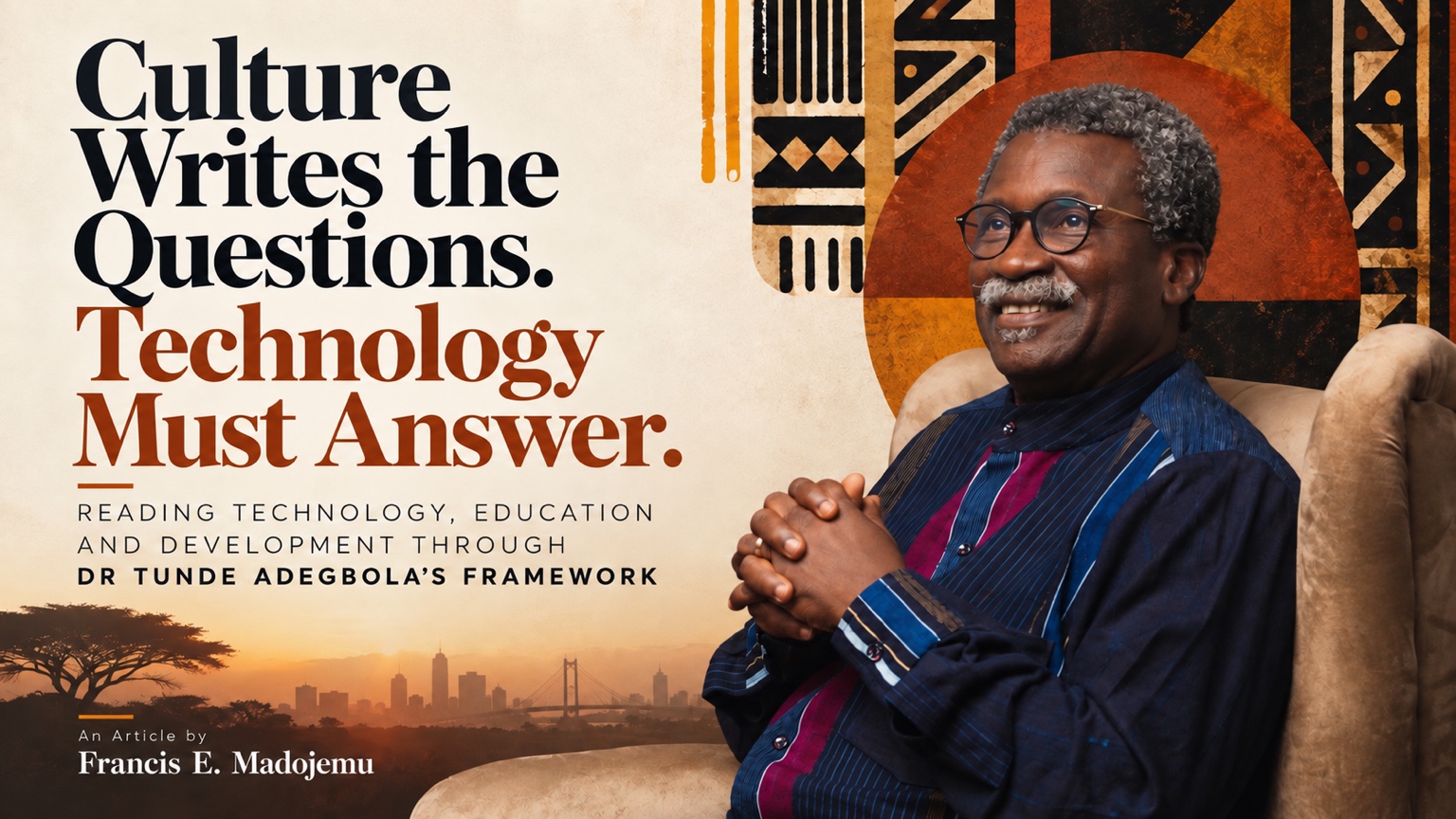
Reading Technology, Education and Development Through Dr Tunde Adegbola’s Framework
Francis E. Madojemu
There is a sentence from Dr Tunde Adegbola that I have not been able to leave alone:
“Technology addresses the needs created by culture. The questions it answers are raised by culture and the problems it solves are formulated by culture.”
It appears almost quietly in his 2025 paper, A Critique of Skills Acquisition in the National Open University of Nigeria (NOUN).
But I think that sentence contains an extraordinary architecture.
It helps connect ideas I have been thinking about, teaching, attempting to build and sometimes struggling to articulate for many years: culture, education, skills, work, creativity, technology, development, entrepreneurship, the Church—and now artificial intelligence.
Adegbola’s proposition gives us somewhere important to begin.
Not with technology.
With culture.
We usually reverse the order.
Artificial intelligence arrives and we ask:
What can we do with AI?
A new social platform arrives and churches ask:
How can we use it?
Computers become cheaper and schools ask:
How do we put computers in classrooms?
A new piece of software appears and businesses ask:
Should we buy it?
But Adegbola’s argument begins before the technology appears.
It begins with how people actually live.
Culture.
And that changes everything.
CULTURE WRITES THE QUESTIONS
Culture is not merely dancing, clothing, language or festivals.
Culture is the accumulated way a people live.
It includes language.
Work.
Food.
Shelter.
Commerce.
Relationships.
Values.
Transportation.
Education.
Religion.
Habits.
Institutions.
Geography.
Environment.
Problems.
Aspirations.
And the methods people develop for navigating all of them.
Every way of life therefore creates particular needs.
Those needs raise questions.
Those questions expose problems.
And those problems create demand for solutions.
This is the significance of Adegbola’s formulation:
“The questions [technology] answers are raised by culture and the problems it solves are formulated by culture.”
That is more than a definition of technology.
It is a theory of development.
It means that if we want to know what technologies a society needs, we should first look carefully at how that society lives and where life continually breaks down.
Culture is constantly giving us information.
Traffic is information.
Poor access to healthcare is information.
Agricultural waste is information.
A child who cannot understand the language of instruction is information.
Small businesses unable to maintain reliable accounts are information.
Young people spending sixteen years in school and emerging without economically useful capabilities are information.
A dysfunctional electricity system is information.
A church whose processes collapse whenever one particular person is absent is information.
Problems are not merely interruptions.
Problems contain intelligence.
They tell us where something needs to work better.
In the language of architecture:
Culture writes the brief.
TECHNOLOGY IS NOT A COMPUTER
This is where Paul Zane Pilzer becomes enormously important.
Long before the present fascination with artificial intelligence, Pilzer was arguing for a much wider understanding of technology.
In teaching material we used in our 2013 iCode programme, Pilzer was quoted defining technology as:
A better method of doing something you already do more efficiently.
That formulation deserves much more attention than we normally give it.
Because it breaks the spell of thinking that technology means electronics.
Pilzer asks us to think much more basically.
Suppose it normally takes thirty minutes to perform a task.
If somebody develops a dependable way of accomplishing the same useful outcome in twenty-five minutes, something has changed technologically.
The new method may involve a computer.
But it may not.
The essential thing is that human beings have discovered a better method.
That means technology can be:
a tool;
a process;
a method;
a machine;
a material;
an organisational system;
a technique;
software;
an algorithm;
or a combination of several of these.
The wheel is technology.
Writing is technology.
A plough is technology.
A pulley is technology.
Concrete is technology.
A bridge is technology.
A printing press is technology.
Double-entry bookkeeping is a technology for financial record keeping.
Refrigeration is technology.
Water purification is technology.
Containerisation transformed shipping through technology.
An assembly line is technology.
Mobile payments are technology.
Artificial intelligence is technology.
We keep mistaking the most visible technologies of an age for the meaning of technology itself.
Pilzer corrects that mistake.
And his argument goes further.
For Pilzer, technology changes the economic value of resources.
A material can sit almost useless until knowledge discovers what can be done with it.
Oil existed before the internal-combustion economy.
Silicon existed before microprocessors.
Electromagnetic waves existed before broadcasting.
The resource was present.
Human knowledge changed what the resource could become.
That insight is particularly important for developing nations.
Possessing natural resources does not by itself create prosperity.
What matters is increasingly what human beings know how to do with them.
Knowledge.
Skill.
Technology.
Organisation.
Productivity.
Value creation.
That is why Pilzer’s argument belongs near the centre of this discussion rather than at its edges.
Adegbola tells us:
where the questions come from.
Pilzer helps us understand:
what technological progress actually does.
Put the two together:
Culture generates needs and problems. Technology develops better methods for answering them.
And when better methods increase productivity, reduce waste, expand access or create previously impossible capability, economic possibilities change.
That is development.
TECHNOLOGY IS REALLY ABOUT HUMAN PURPOSE
The economist and complexity theorist W. Brian Arthur, author of The Nature of Technology, gives another formulation that reinforces this argument.
Arthur describes a technology fundamentally as:
“a means to fulfill a human purpose.”
That is beautifully simple.
Technology does not begin with the machine.
It begins with a purpose.
Something needs to happen.
Human beings then harness knowledge, phenomena, materials, methods or other technologies to make it happen.
Arthur’s work is particularly useful because he does not restrict technology to physical devices.
A method can be technology.
A process can be technology.
An algorithm can be technology.
A machine can be technology.
And technologies frequently arise through combinations of technologies that already exist.
This again brings us back to human problems.
We do not ordinarily invent merely because invention is possible.
Something needs doing.
And we search for a way to do it:
better; faster; more accurately; more safely; more cheaply; with less waste; for more people; or in circumstances where it previously could not be done at all.
That is technology.
STEVE JOBS: THE TOOL IS NOT THE DESTINATION
Steve Jobs expressed essentially the same idea through one of the best metaphors ever used for personal computing.
He described the computer as:
“the equivalent of a bicycle for our minds.”
The story behind the phrase matters.
Jobs referred to a study comparing the efficiency of animal locomotion.
Human beings did not perform particularly impressively.
Then someone calculated the efficiency of a human being riding a bicycle.
Suddenly the human being moved to the top.
The biology had not changed.
The tool had amplified the human being.
That was Jobs’s vision of computing.
A computer was not valuable simply because it was a remarkable machine.
It was valuable because of what happened to human capability when the person gained access to it.
That distinction is vital now that artificial intelligence is everywhere.
The objective should not be:
Put AI everywhere.
The objective should be:
Enable human beings to do worthwhile things they could not previously do—or to do them significantly better.
The bicycle is not the destination.
The rider is going somewhere.
The computer is not the destination.
AI is not the destination.
Technology is a vehicle.
That should sound familiar.
It is the same conceptual move we make when we say that relationships are vehicles: the vehicle matters because of where it carries human beings.
And Jobs himself eventually warned against technological magical thinking in education.
Simply putting computers into schools did not automatically solve educational failure.
That is important.
You can have the newest technology and still address the wrong problem.
A classroom with tablets and poor pedagogy still has poor pedagogy.
A church with LED screens and weak discipleship still has weak discipleship.
A business with sophisticated software and no processes merely digitises confusion.
An AI system introduced into a dysfunctional workflow may simply make dysfunction faster.
Technology is not automatically transformation.
It must be connected to a correctly understood problem.
Which takes us back again to Adegbola:
What question did culture actually ask?
A REFRIGERATOR IS AN ANSWER
Once we understand technology this way, ordinary life looks different.
A refrigerator is an answer to deterioration.
A borehole is an answer to difficulty accessing water.
A bridge answers the obstacle created by geography.
A telephone answers distance.
A printing press answers the difficulty of reproducing information.
Eyeglasses answer limitations of vision.
A tractor answers limitations of human and animal labour.
Vaccination answers particular biological vulnerabilities.
A search engine answers information retrieval.
GPS answers location and navigation.
Mobile money addresses transaction friction and financial access.
Video conferencing addresses geographical separation.
AI increasingly addresses problems associated with cognition, language, pattern recognition, prediction, translation, analysis and the cost or scarcity of certain forms of expert assistance.
So perhaps the right question whenever a new technology appears is not:
What is the technology?
but:
What human limitation, difficulty or opportunity does it alter?
Now we are thinking more deeply.
WETIN BE AI SEF?
This is one reason Dr Adegbola’s keynote for our Wetin Be AI Sef? programme becomes so relevant to this argument.
The title itself was intentional.
Not:
What is Artificial Intelligence?
But:
Wetin be AI sef?
Let us bring the question close enough for ordinary people to interrogate it.
In that keynote, Adegbola begins by stripping AI of mystery.
Artificial means something made by human hands or human minds.
His memorable language is:
“A human being was here.”
That matters.
AI did not fall from the sky.
Human beings built artefacts and knowledge systems.
And when he moves to intelligence, he does something even more useful for our argument.
He relates intelligence to our need to know.
Human beings need information because they must:
make decisions and take actions.
That is a crucial connection.
Knowledge is not merely for storage.
We know in order to navigate life.
To choose.
To decide.
To act.
Adegbola explains that traditional computing originally assisted human knowing largely in two ways:
Remembering — storing and retrieving information.
Calculating — processing information.
Databases extended memory.
Computing extended calculation.
But AI began to push further.
Toward inference.
Rules.
Pattern recognition.
Learning from historical data.
Prediction.
Language.
Generation.
What began as machines helping us remember and calculate increasingly became machines able to assist parts of the process by which humans attempt to know enough to act.
That is an extremely important way to understand artificial intelligence.
AI is not interesting merely because a machine can produce words.
The deeper question is:
What decisions and actions can human beings now perform differently because the cost, speed or accessibility of certain forms of knowing has changed?
That is precisely where the keynote joins the larger argument of this article.
BUT WHOSE KNOWLEDGE?
Then Adegbola reaches one of the most important issues in his keynote.
Data.
His slides move toward:
algorithm bias or data bias; the data problem for Africa; linguistic gas flaring; responsible AI.
And this is where the culture argument becomes unavoidable.
Artificial intelligence learns from data.
But data does not arise outside culture.
Data records human activity.
Languages.
Documents.
Images.
Transactions.
Books.
Conversations.
Institutions.
Decisions.
Categories.
Assumptions.
Priorities.
History.
A model trained overwhelmingly on one civilisation’s recorded knowledge cannot mysteriously acquire another civilisation’s poorly documented reality.
That is why Adegbola’s metaphor of linguistic gas flaring is so powerful.
Nigeria speaks enormous quantities of Yoruba, Hausa, Igbo and hundreds of other languages every day.
Radio broadcasts.
Television.
Conversations.
Courts.
Markets.
Churches.
Stories.
Teaching.
Knowledge.
But vast amounts disappear into the air because they are never captured, digitised, structured or made available for computation.
In his later Future of Work conversation, Adegbola described data as the currency of the information age and warned that where African language data is not deliberately curated, future systems will continue learning from what other societies have recorded.
This gives his culture-and-technology proposition a startling new significance in the age of AI.
If:
culture formulates the questions technology must answer,
then technology needs sufficiently rich access to that culture to understand the question.
This is no longer merely about cultural pride.
It is about technological competence.
It is about economic participation.
It is about education.
It is about representation.
It is about what Adegbola calls digital justice.
And it is about who gets to shape the intelligence systems through which more and more of the world will work.
The first hour of Dr Adegbola’s Wetin Be AI Sef? keynote therefore belongs naturally in this conversation, because it shows the continuity between intelligence, information, decisions, action, data, language and culture.
His argument is not:
Everybody must become fascinated with AI.
It is closer to:
Human beings seek knowledge in order to act intelligently; technologies extend that capacity, but those technologies will necessarily reflect the information and cultures from which they are built.
That is a much more important conversation.
WE WERE ALREADY ASKING SOME OF THESE QUESTIONS
Returning to our own old material has been revealing for me.
Not because it means we invented Adegbola’s argument.
We did not.
It explains instead why his argument resonates so deeply with me.
When I returned to our 2013 iCode material, there was Pilzer:
technology as a better way of doing something more efficiently.
There was our concern that children should not merely operate computers.
We wanted them to understand that computers could be instructed.
That code was not magic.
That someone had made what they were using.
The deeper objective was not to produce a generation in which every child became a software engineer.
It was to change posture.
From:
user → maker.
From:
consumer → creator.
We were already worried about young people living increasingly through screens whose underlying logic they did not understand.
Coding was a way of saying:
You do not have to merely inhabit somebody else’s technology.
You can understand.
You can imagine.
You can instruct.
You can create.
That principle is even more relevant in an AI world.
IBRIDGE HUB: START WITH THE ISSUE, NOT THE APP
When I went further back through material from iBridge Hub, another connection became even clearer.
We were trying to bring:
people, business and technology together.
At our Innovation Labs we described our work as:
“Co-creating human-centred design solutions to real world problems in our community.”
But an old distinction particularly caught my attention.
We contrasted:
“I have an idea for an app—I wonder what it could be used for?”
with:
“I see an issue—can I design something to solve it?”
Those two sentences contain two completely different philosophies of technology.
The first begins with the technology.
Then searches desperately for relevance.
The second begins with life.
With culture.
With human experience.
With friction.
With a problem.
Then it searches for an appropriate response.
Adegbola has now given me better language for what we were trying to do.
Culture formulates the problem.
Technology should answer it.
OUR PROBLEMS MAY BE OUR GREATEST UNTAPPED RESOURCE
This changes the way we see problems.
We normally experience problems as nuisances.
We complain.
We blame.
We endure.
We adapt.
Eventually societies can become so accustomed to dysfunction that dysfunction becomes culture.
Generators become normal because electricity is unreliable.
People spend extraordinary time in traffic and reorganise their lives around it.
Businesses build elaborate informal methods around dysfunctional formal systems.
Parents create workarounds for weak schooling.
Church leaders personally carry processes because systems have never been designed.
But every persistent problem is simultaneously telling us:
Something could work better.
Perhaps problems are an overlooked natural resource.
Nigeria has oil.
Gas.
Minerals.
Land.
Sunlight.
People.
But Nigeria also possesses an extraordinary abundance of unsolved problems.
And every unsolved problem contains the possibility of:
research;
education;
skill development;
enterprise;
innovation;
technology;
employment;
investment;
and service.
This is not romanticising suffering.
A bad road is still a bad road.
Poor healthcare still costs lives.
Educational failure is not an entrepreneurial blessing to the child it damages.
But once a problem exists, the responsible question becomes:
What can we learn from it, and what can we build?
That is the architect’s instinct.
The site presents constraints.
The constraints become part of the brief.
Difficulty creates design questions.
Which is why a thought I have been developing elsewhere belongs here:
Difficulty can be a design brief.
GOD DID NOT ONLY GIVE US PRAYER. HE GAVE US CAPACITY.
This is also where Scripture enlarges the argument.
The first thing the Bible tells us about God is:
“In the beginning God created the heaven and the earth.”
Genesis 1:1, KJV
Creation.
Making.
Bringing what is not presently visible into actuality.
And then humanity is placed inside that world with responsibility.
“And God blessed them, and God said unto them, Be fruitful, and multiply, and replenish the earth, and subdue it…”
Genesis 1:28, KJV
Human beings inherit a world full of potential.
But potential is not actuality.
A tree may contain timber.
It does not contain a finished table.
Iron ore is not a bridge.
Silica is not a microprocessor.
A seed is not a farm.
Potential requires human engagement.
Knowledge.
Discovery.
Skill.
Tools.
Work.
Organisation.
This corresponds beautifully with another of Adegbola’s formulations.
In discussing work, he describes work as the movement from potentiality to actuality.
That is a powerful way to see vocation.
Work is not merely what we endure to receive money.
Work is one of the ways human beings participate in bringing possibilities into useful reality.
BEZALEL: THE SPIRIT OF GOD PRODUCED CAPABILITY
Then we arrive at one of Scripture’s most extraordinary passages about work.
“And the LORD spake unto Moses, saying, See, I have called by name Bezaleel the son of Uri, the son of Hur, of the tribe of Judah: And I have filled him with the spirit of God, in wisdom, and in understanding, and in knowledge, and in all manner of workmanship, To devise cunning works, to work in gold, and in silver, and in brass, And in cutting of stones, to set them, and in carving of timber, to work in all manner of workmanship.”
Exodus 31:1–5, KJV
Look at the vocabulary:
Spirit. Wisdom. Understanding. Knowledge. Workmanship. Design. Materials. Making.
There is no biblical conflict here between spirituality and technical competence.
God fills a man with His Spirit and something becomes better made.
That should challenge us.
The Spirit does not merely give Bezalel something to say.
He enables him to design.
To understand materials.
To make.
To execute.
The spiritual manifestation in Exodus 31 is partly craftsmanship.
This deserves far more attention in our churches.
We have sometimes behaved as though the higher expression of spirituality is verbal.
Preaching.
Prophecy.
Prayer.
Song.
Yet the same Spirit who inspires speech can inspire workmanship.
A building can reveal wisdom.
A system can reveal wisdom.
An enterprise can reveal wisdom.
A curriculum can reveal wisdom.
An algorithm can reveal wisdom.
A solution to a farmer’s problem can reveal wisdom.
NOAH RECEIVED REVELATION—AND THEN BUILT
Noah gives us another pattern.
God reveals something about the future.
But revelation is not the ark.
“Make thee an ark of gopher wood; rooms shalt thou make in the ark, and shalt pitch it within and without with pitch.”
Genesis 6:14, KJV
The revelation creates an assignment.
Then there is:
design;
measurement;
materials;
construction;
labour;
process.
God reveals.
Noah builds.
The warning alone does not preserve life.
Something must be constructed because of what has been heard.
This is a pattern I increasingly recognise:
What must we build because of what we have heard?
That is the architect’s question following the prophet’s revelation.
JOSEPH: REVELATION NEEDED A SYSTEM
Joseph makes the relationship even clearer.
Pharaoh receives troubling dreams.
Joseph receives understanding.
A famine is coming.
But Joseph does not finish by saying:
Thus saith the Lord.
The revelation becomes a strategy.
Joseph moves from:
forecast → policy → taxation/collection → storage infrastructure → administration → record keeping → logistics → distribution.
Revelation identified the future.
But revelation did not construct the granaries.
Revelation did not transport the grain.
Revelation did not administer distribution.
Human beings had to convert divine insight into organised capability.
Perhaps we have sometimes expected revelation to perform the work revelation was intended to direct.
DISCOVERY AND REVELATION
This connects to another important Adegbola distinction:
discovery and revelation.
In his Real Success teaching, he described discovery essentially as humans removing the cover and revelation as God removing the cover.
The two should not become enemies.
We can make two opposite mistakes.
One mistake is to say:
God will do it.
And neglect learning.
Study.
Research.
Expertise.
Skill.
Experiment.
The other mistake is to discover the power of human knowledge and begin acting as though God is unnecessary.
Adegbola’s framework refuses both errors.
Discovery and revelation can be complementary.
One of the statements from those earlier sessions has stayed with me:
A person may receive revelation regarding a problem yet lack the knowledge necessary to solve the problem the revelation has exposed.
That is sobering.
Revelation does not make ignorance a virtue.
KNOWLEDGE IS NOT SKILL
This is precisely why education becomes central.
Adegbola’s 2025 paper distinguishes knowledge from skill.
Knowledge is associated with understanding.
Know what.
Know why.
Skill is practical.
Know how.
And skill develops through repeated performance and practice.
That distinction exposes one of our educational crises.
We have frequently confused:
certification with education;
and:
education with information.
A person passes examinations.
Receives a certificate.
Can discuss a subject.
And we say:
educated.
But can the person perform?
Can the person diagnose?
Can the person design?
Can the person repair?
Can the person organise?
Can the person build?
Can the person solve?
Can the person take knowledge and create value for somebody else?
This is where one of my own older phrases meets Adegbola’s argument:
CERTIFICATED BUT NOT EDUCATED.
In our old Get Educated material, I argued that skills rather than certificates were ultimately essential to survival and productivity.
Training mattered because teaching by itself was insufficient.
And I said the same problem had entered the Church.
We had Bible schools.
Conferences.
Seminars.
Services.
Endless teaching.
Knowledge flowing everywhere.
But often without the training, practice, responsibility and opportunity necessary to convert that knowledge into skill.
Perhaps churches can become:
SERMONISED BUT NOT TRAINED.
THE DEVELOPING-WORLD QUESTION
Adegbola then makes a particularly important distinction for countries like Nigeria.
In wealthy knowledge-producing economies, universities can understandably concentrate significantly on extending the frontiers of knowledge.
But Nigeria faces another urgent responsibility.
Much human knowledge already exists and is increasingly accessible globally.
A developing society urgently needs to convert available knowledge into skills and useful capability.
That is crucial.
We do not have to rediscover Ohm’s law.
We do not have to independently invent calculus again.
We do not need to begin physics from zero.
There are enormous bodies of existing knowledge.
The question is:
What can our people do with what humanity already knows?
Can knowledge become:
better housing?
better agriculture?
better logistics?
better education?
better public administration?
better medicine?
better businesses?
better construction?
better energy?
better institutions?
That is development.
PAUL PILZER MAKES THE ECONOMIC IMPLICATION CLEAR
This is where Pilzer becomes even more important.
If technology is a better method of doing what human beings already need to do, technological progress changes productivity.
Productivity means that the same human effort can increasingly generate more useful output.
That matters enormously.
An economy does not become wealthy primarily by everyone working physically harder.
It becomes wealthier when knowledge and technology allow effort and resources to produce more value.
A farmer using only manual tools can work extraordinarily hard.
A farmer with irrigation, mechanisation, improved seed varieties, reliable weather data, refrigeration and market information possesses an entirely different productive capacity.
Hard work matters.
But hard work multiplied by knowledge, skill and technology becomes something else.
This is why technology can redefine wealth.
And it helps explain why a nation can possess enormous natural resources yet remain economically weak.
Resources in the ground are potential.
The capacity to transform them into useful value is what makes them economically significant.
Knowledge changes resources.
Technology changes productivity.
Skill determines whether people can use the technology.
Education determines whether those skills can spread.
Institutions determine whether solutions can operate reliably at scale.
Now Adegbola and Pilzer sit directly beside one another.
Adegbola: culture formulates the problems.
Pilzer: technology develops better and more efficient ways of addressing what people already need to do.
That pairing deserves to sit at the centre of any serious Nigerian conversation about education and development.
EDUCATION FOR ALL MUST THEREFORE MEAN MORE THAN SCHOOL FOR ALL
This completely changes the meaning of Education for All.
The older developmental question was rightly:
Can every child get into school?
That remains morally important.
But school attendance is not the final objective.
A child can attend school and remain incapable.
A university graduate can possess a certificate and remain economically excluded.
Someone can have internet access and lack the capacity to benefit from it.
Someone can possess a smartphone yet function almost entirely as a consumer inside systems created by other people.
Education for All must therefore become something deeper:
Every person should have a credible pathway from ignorance to understanding, from understanding to skill, and from skill to productive participation.
That pathway includes:
language;
knowledge;
tools;
practice;
feedback;
technology;
mentorship;
opportunity;
and eventually contribution.
Education for All should not simply democratise information.
It should democratise capability.
THE LAST SIX INCHES
This is where Adegbola’s lifetime work around African languages becomes profoundly developmental.
You can take fibre optic cable to a village.
You can install internet access.
You can place a device in front of someone.
Politically, you may announce that the digital divide has been solved.
But there is still a final distance.
The distance between the screen and the human being.
Adegbola has described it as the last six inches.
Language has to cross that distance.
If technology only works effectively for people who first have to abandon their linguistic reality, access is incomplete.
His old statement in our iCode material was wonderfully direct:
“The Computer needs to speak our language and vice versa.”
Until technologies work appropriately with local languages and with applications relevant to ordinary people’s lives, they remain foreign to large sections of society.
This was prescient in 2013.
It is even more urgent in 2026.
Because in the AI age, language determines participation in a much deeper way.
AI MAY BE THE GREATEST EDUCATION-FOR-ALL OPPORTUNITY WE HAVE SEEN
For centuries, excellent personalised education was expensive.
One excellent teacher could interact deeply with only a limited number of students.
Books were expensive.
Travel was difficult.
Specialist knowledge was geographically concentrated.
Language restricted access.
Technology progressively changed those constraints.
Writing externalised memory.
Printing scaled written knowledge.
Radio scaled voice.
Television scaled audiovisual explanation.
The internet scaled access to information.
Online video scaled teachers and demonstrations.
Smartphones placed extraordinary information capability in billions of hands.
AI may now begin to scale something else:
cognitive assistance.
Imagine a child who does not understand an explanation.
The child can ask again.
Ask differently.
Ask for an example.
Ask for a picture.
Ask for the explanation at a simpler level.
Ask for a translation.
Ask to be tested.
Ask for practice.
Ask for feedback.
Ask the machine not to give the answer but to guide the thinking.
Potentially:
one concept;
many explanations;
many languages;
many levels;
at enormous scale.
That is extraordinary.
But Adegbola’s framework gives us the necessary correction.
The question is not:
How quickly can we introduce AI into African schools?
The question is:
What educational problem are we trying to solve?
Teacher scarcity?
Language?
Practice?
Feedback?
Reading difficulty?
Teacher preparation?
Curriculum relevance?
Access to specialists?
Visualisation?
Assessment?
Administrative burden?
Different problems require different solutions.
Start with the problem.
Then determine whether AI is an appropriate technology for solving it.
THE CULTURE ITSELF BECOMES CURRICULUM
One of my favourite Adegbola stories concerns being taught concepts such as summer solstice and winter solstice while growing up in Nigeria.
He learned the words.
He passed the examinations.
But the experience to which the concepts referred was largely absent from his environment.
Years later, travelling abroad and seeing daylight at times that contradicted his Nigerian expectations, the ideas became experientially meaningful.
Meanwhile his own Yoruba environment contained natural phenomena, agricultural knowledge, language and survival intelligence that formal education often did not consider worthy of systematic study.
This is not an argument against universal knowledge.
A Nigerian child should understand the solar system.
A Nigerian scientist should understand global science.
A Nigerian mathematician should participate in universal mathematics.
The point is different.
Education should help people understand reality.
And reality begins somewhere.
Our rivers.
Soil.
Markets.
Buildings.
Weather.
Diseases.
Food.
Transport.
History.
Language.
Agriculture.
Family structures.
Trade.
Local industries.
Problems.
Then education connects that immediate reality to the wider human store of knowledge.
Otherwise education becomes the strange achievement of knowing enormous amounts about elsewhere while lacking intellectual tools for understanding where one actually lives.
PERHAPS OUR PROBLEMS SHOULD BECOME PART OF OUR CURRICULUM
What if we told Nigerian young people:
Traffic is not merely something to complain about.
Study it.
Waste disposal is not merely government’s problem.
Study it.
Why do farmers lose produce between the farm and consumer?
Study it.
Why are buildings expensive?
Study it.
Why do small businesses fail to maintain records?
Study it.
Why do our public institutions require so much physical paperwork?
Study it.
Why do children struggle with particular subjects?
Study it.
Why does a church process repeatedly fail?
Study it.
Why does a generator battery continually fail?
Study it.
Then:
understand;
research;
learn;
experiment;
design;
build.
Now Nigeria becomes a laboratory.
Now culture becomes curriculum.
Now education becomes development.
LEKE ALDER: DO NOT CONFUSE GADGETS WITH TECHNOLOGY
Leke Alder adds another important dimension, particularly for the Church.
Churches can say they are technological because they possess cameras.
Screens.
Livestreaming equipment.
Social media accounts.
Lighting systems.
Apps.
But that can still represent a shallow engagement with technology.
Alder’s important contribution is his insistence that technology is embedded inside changing social and cultural realities.
Social media is not merely another microphone.
It changes participation.
Communication.
Authority.
Community.
Identity.
Interaction.
Technology answers culture.
But once widely adopted, technology also begins to reshape culture.
This creates a feedback loop:
CULTURE → NEED → PROBLEM → TECHNOLOGY → NEW BEHAVIOUR → CHANGED CULTURE → NEW NEED → NEW PROBLEM.
The smartphone is an obvious example.
Human beings already wanted communication.
Information.
Entertainment.
Connection.
The smartphone answered those existing needs.
Then the smartphone transformed:
photography;
banking;
dating;
shopping;
navigation;
news;
recruitment;
work;
learning;
friendship;
parenting;
politics;
church.
The technology that emerged from culture returned to alter culture.
This is why merely adopting gadgets produced elsewhere is not enough.
We must understand the human changes occurring around them.
SORIYAN: CULTURE SHAPING IS NOW URGENT
Olakunle Soriyan’s recent arguments add urgency rather than origin to this conversation.
His challenge to the Church is increasingly that believers cannot define Christian effectiveness only by what happens inside congregational space.
Culture is also formed through:
enterprise;
technology;
education;
media;
science;
government;
capital;
creativity;
institutions.
That argument is important.
But I would place it downstream from Adegbola and Pilzer.
Adegbola gives us the architecture.
Pilzer helps define technology operationally and economically.
Jobs shows us technological amplification.
Arthur gives us the purpose-oriented theoretical formulation.
Soriyan tells us something about the urgency of the present moment:
these systems are now among the environments in which contemporary culture is being formed.
The Church cannot withdraw from them and then complain about the culture they produce.
THE CHURCH’S QUESTION IS TOO SMALL
Much church discussion about technology still begins here:
How can technology help us do church?
How can we livestream better?
How can we promote the programme?
How can we improve our social media?
How can we project Scriptures?
How can people give electronically?
All useful questions.
But they are too small.
The larger Kingdom question is:
How can people formed by Christ use truth, wisdom, knowledge, skill, science, technology, enterprise, creativity and institutions to serve human beings and improve life?
That produces a very different understanding of ministry.
A teacher can be doing Kingdom work without becoming a preacher.
An engineer can.
A software developer can.
A doctor can.
An architect can.
A farmer can.
A researcher can.
An entrepreneur can.
A scientist can.
An artist can.
A civil servant can.
A technologist can.
The issue is not whether they put a Bible verse on their product.
The issue is whether the life, truth, wisdom, character and service of God’s Kingdom enter their work.
ACTS 6: SOMETIMES THE SPIRITUAL ANSWER IS BETTER ADMINISTRATION
Acts 6 gives us a surprisingly relevant example.
The early church encounters a distribution problem.
A group of widows is being neglected.
It is relational.
Ethnic.
Pastoral.
Material.
Administrative.
The apostles do not merely rebuke everyone for lacking love.
Neither do they announce seven days of prayer to make food mysteriously reach the neglected widows.
They redesign the system.
“Wherefore, brethren, look ye out among you seven men of honest report, full of the Holy Ghost and wisdom, whom we may appoint over this business.”
Acts 6:3, KJV
Notice again:
Holy Spirit. Wisdom. Administration.
A spiritual church redesigned a process because people were not being served properly.
That is important.
Sometimes compassion requires a system.
Sometimes love needs logistics.
Sometimes justice requires better administration.
And sometimes the answer to a recurring prayer point is a better process.
FROM IDEAS TO IMPLEMENTATION
This also touches something we have been wrestling with recently in leadership.
There is a difference between:
knowing what should happen
and:
having the capacity and ownership to make it happen repeatedly.
A suggestion is knowledge.
Implementation requires skill.
A good intention is not a process.
An idea is not a system.
A sermon about excellence is not excellent execution.
A sermon about stewardship does not reconcile the accounts.
A sermon about leadership does not produce accountable leadership.
A sermon about compassion does not automatically create a functioning distribution system.
This is another version of Adegbola’s distinction:
know what versus know how.
And perhaps it explains why systems and processes have become such a major part of my own thinking.
A good solution must eventually become repeatable beyond the heroic effort of one person.
That is what systems do.
THE SPINE
The architecture is now becoming increasingly clear to me:
GOD / TRUTH / PURPOSE
↓
HUMAN LIFE & CULTURE
↓
NEEDS / DIFFICULTIES / QUESTIONS
↓
OBSERVATION / DISCOVERY / REVELATION
↓
EDUCATION
↓
KNOWLEDGE
↓
TRAINING / PRACTICE
↓
SKILL / CAPABILITY
↓
DESIGN
↓
TECHNOLOGY
↓
BETTER METHODS / GREATER PRODUCTIVITY
↓
SYSTEMS
↓
ENTERPRISE / INSTITUTIONS
↓
SERVICE
↓
HUMAN FLOURISHING
↓
CULTURE CHANGES
↓
NEW NEEDS AND QUESTIONS APPEAR
And the cycle continues.
Adegbola gives us the hinge:
Culture creates the need and formulates the problem technology must answer.
Pilzer gives us the operational movement:
Technology finds better and more efficient ways of doing what human beings need to do.
Arthur reminds us of the purpose:
Technology exists to fulfil human purposes.
Jobs reminds us of amplification:
The tool should enlarge human capability.
Education develops the human being who can participate in all of this.
Skill converts knowledge into capacity.
Systems make the capacity repeatable.
Enterprise and institutions scale and sustain the solution.
And culture is changed by the result.
TECHNOLOGY IS NOT THE SAVIOUR
There is an important caution.
Technology will not redeem humanity.
It cannot reconcile humanity to God.
It cannot guarantee justice.
It cannot manufacture love.
It cannot eliminate greed.
It cannot cure the human tendency to use power destructively.
Indeed, technology can magnify human evil as effectively as human good.
Adegbola acknowledges this.
Powerful technology increases our capacity in both directions.
That is why Responsible AI appears near the end of his Wetin Be AI Sef? presentation.
The question cannot simply be:
Can we build it?
It must also include:
Should we?
Who benefits?
Who is harmed?
Whose data was used?
What assumptions are embedded?
Who is excluded?
Who is accountable when the system fails?
What human dignity must never be surrendered merely because something is efficient?
Technology does not eliminate morality.
It increases the importance of morality.
AFRICA MUST NOT REMAIN A CONSUMER INSIDE SOMEONE ELSE’S IMAGINATION
This may be one of the greatest implications of Adegbola’s work.
If Africa merely consumes technology created elsewhere, then we will largely consume answers to questions other societies decided were worth asking.
Their languages will dominate.
Their data will dominate.
Their assumptions will dominate.
Their markets will shape product priorities.
Their definitions of normality will enter the systems.
This does not mean foreign technology is bad.
That would be absurd.
Human civilisation has always advanced through exchange.
It means something more demanding:
We must become contributors.
We must document.
Research.
Experiment.
Build.
Create data.
Develop skills.
Train models.
Solve local problems.
Export solutions.
Participate in defining the future.
Adegbola’s concern about African languages is therefore not nostalgic.
It is futurist.
If our culture formulates questions but our culture is invisible in the datasets from which future systems learn, we will increasingly inhabit systems that cannot fully hear the questions we are asking.
FROM USERS TO MAKERS
This takes us back to iCode.
Teaching children to code was never really about producing millions of coders.
It was about agency.
Understanding that the screen is not magic.
Someone built this.
Someone made choices.
Someone wrote instructions.
Someone decided how the system would behave.
Once a child understands that:
technology stops being an unquestionable environment;
and becomes something human beings can interrogate and shape.
That transition is profound:
CONSUMER → CREATOR
USER → MAKER
AUDIENCE → PARTICIPANT
And perhaps now:
AI USER → AI PROBLEM SOLVER
The question is no longer:
What prompts do you know?
It becomes:
What problem can you now solve that you could not solve before?
THIS MAY EXPLAIN MORE OF MY OWN JOURNEY THAN I REALISED
Looking backwards, I can now see continuity in work I previously regarded as different projects.
Architecture taught me that problems become briefs.
Ministry taught me that revelation demands response.
ReCLAIM asked how culture shapes behaviour.
Real Success asked how knowledge becomes productive life.
iBridge Hub attempted to bring community problems and technological capacity together.
iCode attempted to move young people from digital consumers toward digital creators.
Innovation Kitchen asked how ideas can become solutions.
Our teaching on craftsmanship insisted that Spirit and skill belong together.
NuStreams created physical infrastructure for people to gather, learn, perform, create, meet and build.
Our work on systems and processes has increasingly insisted that good intentions need reliable mechanisms.
BridgeWorks asks how human capability is actually developed.
Market Day Live asks entrepreneurs to move from:
What can I sell?
to:
Whom can I serve, and what problem do they actually have?
Education for All asks how every human being can gain access not merely to information but to the capacity to participate.
And now artificial intelligence brings many of these questions into the same room.
I do not think that makes all these projects the same.
Nor do I want to rewrite history and pretend there was always one perfectly articulated theory behind them.
There wasn’t.
But there was a direction.
And Adegbola’s formulation helps me see it more clearly:
Human beings live inside culture. Culture creates problems. Problems demand knowledge. Knowledge must become skill. Skill can create better methods. Better methods become technology. Technology can become systems. Systems can improve human life.
And then the changed life produces new culture.
FROM “WHAT CAN I SELL?” TO “WHOM CAN I SERVE?”
There is also a direct entrepreneurial consequence.
Business education often begins with products.
What can I manufacture?
What can I import?
What app can I build?
What can I sell?
But Adegbola’s framework pushes the entrepreneur backwards.
Before the product:
culture.
Then:
need.
Then:
problem.
Then:
solution.
Then:
technology.
Then:
product or service.
This connects directly with a thought we have been developing in Market Day Live:
Business changes when the question moves from “What can I sell?” to “Whom can I serve?”
The entrepreneur is not primarily someone who has something to sell.
The entrepreneur notices unresolved human friction and organises resources to address it.
That is technology.
That is innovation.
That is enterprise.
And at its best:
that is service.
“LET YOUR LIGHT SO SHINE”
This brings me eventually back to Jesus.
“Ye are the light of the world. A city that is set on an hill cannot be hid.”
And then:
“Let your light so shine before men, that they may see your good works, and glorify your Father which is in heaven.”
Matthew 5:14,16, KJV
The world sees:
good works.
Something visible.
Something beneficial.
Something happened.
A burden became lighter.
A child understood.
A farmer produced more.
A patient received care.
A disabled person gained access.
A business became productive.
A language became computationally visible.
A worker gained a skill.
A community gained clean water.
A process became fairer.
A system became more reliable.
Somebody had a problem.
And somebody built an answer.
Perhaps that is one of the places where technology, vocation and the Kingdom meet.
PERHAPS WE NEED A DIFFERENT TECHNOLOGY QUESTION
The Church’s technology question has often been:
How can technology help us preach better?
I think the question now needs to become much larger.
How can people formed by Christ use wisdom, knowledge, skill, creativity, science, technology, enterprise and institutions to serve human beings better?
And perhaps our educational question also changes.
Not merely:
How many people are in school?
But:
How many people are becoming capable?
Our AI question changes.
Not merely:
Who has access to AI?
But:
Whose capability has increased because of it?
Our entrepreneurship question changes.
Not merely:
What are people selling?
But:
What human problems are they solving?
And our church question changes.
Not merely:
How many people gathered?
But:
What flowed from what they received into the world?
THE SENTENCE I WOULD LIKE US TO REMEMBER
After all this, I return to Dr Tunde Adegbola.
His statement remains the intellectual hinge of this entire argument:
“Technology addresses the needs created by culture. The questions it answers are raised by culture and the problems it solves are formulated by culture.”
That means the first place we should search for technological opportunity is not Silicon Valley.
It may be the road outside our house.
The classroom.
The market.
The farm.
The hospital.
The courtroom.
The church office.
The workshop.
The language somebody speaks to their grandmother.
The daily frustration everyone has normalised.
The thing that continually breaks.
The thing everybody complains about.
The process that wastes three hours when it should take ten minutes.
The child who keeps failing because nobody has found another way to explain the idea.
Culture is speaking.
Culture is asking questions.
And perhaps we have spent too much time importing answers without first learning to hear the questions.
THE FINAL ARCHITECTURE
So I would reduce the whole essay to this:
CULTURE REVEALS THE NEED.
THE NEED FORMULATES THE PROBLEM.
EDUCATION DEVELOPS THE HUMAN BEING CAPABLE OF UNDERSTANDING IT.
KNOWLEDGE EXPLAINS.
TRAINING CONVERTS KNOWLEDGE INTO SKILL.
WISDOM DESIGNS.
TECHNOLOGY CREATES A BETTER METHOD.
SYSTEMS MAKE THE METHOD REPEATABLE.
ENTERPRISE AND INSTITUTIONS SCALE AND SUSTAIN IT.
SERVICE GIVES IT PURPOSE.
HUMAN LIFE IMPROVES.
CULTURE CHANGES.
AND CHANGED CULTURE RAISES NEW QUESTIONS.
That is not merely a theory of technology.
It is a theory of education.
A theory of work.
A theory of innovation.
A theory of enterprise.
A theory of development.
And, I increasingly believe, it gives the Church a far richer understanding of what it means to release Spirit-filled people into the world.
Because perhaps the final question is not:
How much revelation have we received?
Perhaps it is also:
What have we built because of what we have seen?
PRINCIPAL SOURCES AND ATTRIBUTIONS
Dr Tunde Adegbola — A Critique of Skills Acquisition in the National Open University of Nigeria (NOUN), 2025. The foundational source for this essay’s central proposition concerning culture, needs, skills and technology. His paper distinguishes practical skill from knowledge and argues that Nigeria’s developmental situation particularly requires converting available knowledge into useful capability.
Dr Tunde Adegbola — Wetin Be AI Sef? keynote. The keynote develops AI through the human need to know in order to make decisions and act; the progression from computation as memory/calculation toward machine learning and generative AI; and the implications of data bias, Africa’s data deficit, linguistic gas flaring and Responsible AI.
Watch Dr Tunde Adegbola’s Wetin Be AI Sef? keynote
Dr Tunde Adegbola — Future of Work. Particularly relevant to work as the transformation of potentiality into actuality, African language data, digital justice, human dignity and the responsibility to engage rather than retreat from technology.
Paul Zane Pilzer. His technology thesis—preserved in my 2013 iCode teaching material—is particularly important to this article: technology should be understood not simply as electronics but as a better method of accomplishing something more efficiently. His wider economic argument connects technological knowledge to productivity, changing resource value and wealth creation.
Original iCode presentation containing the Pilzer material
W. Brian Arthur — The Nature of Technology. Arthur’s description of technology as a means of fulfilling human purpose provides an important theoretical complement to Adegbola and Pilzer.
W. Brian Arthur — The Nature of Technology
Steve Jobs. His “bicycle for the mind” metaphor frames computing as amplification of human capability rather than an end in itself. (Bike4Mind)
Francis E. Madojemu / iBridge Hub / iCode. The historical references to iCode, iBridge Hub, Innovation Labs, ReCLAIM, Innovation Kitchen and later projects are included as examples of my own attempts over the years to work through questions of culture, skill, technology, problem-solving and human capability—not as the intellectual source of Dr Adegbola’s framework.
Above all, the governing theological source for the argument remains Scripture.