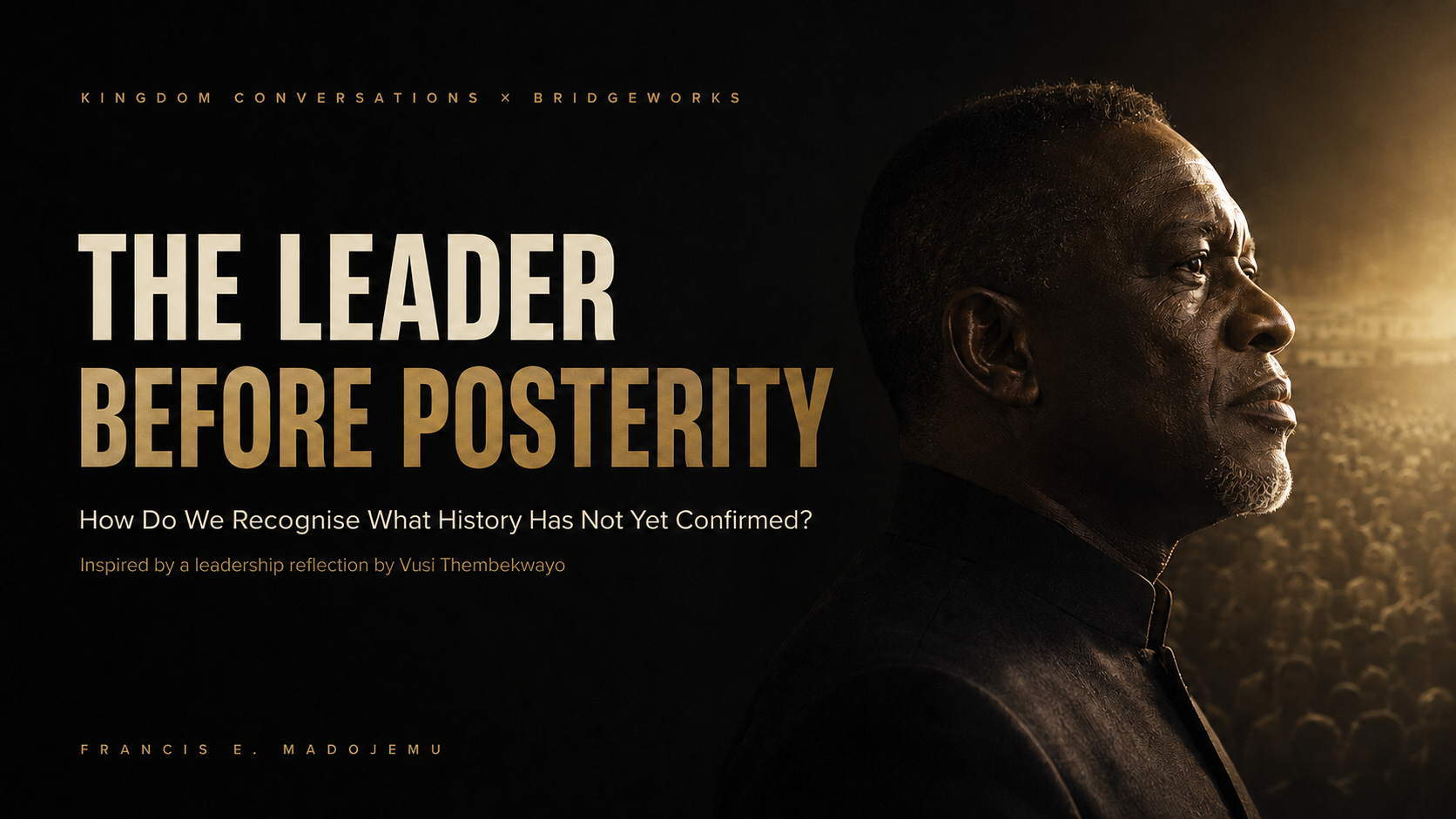
The Form Changed. The Presence Remained.
By Pastor Francis E. Madojemu
This reflection was inspired by Mimi Kalinda’s thought-provoking article “What Kobe and Duncan Teach Us About Story, Power and the Price of Visibility.” I encourage readers to read her original article, which can be found here:
Recently I encountered a fascinating article by Mimi Kalinda comparing two NBA legends:
Kobe Bryant.
And Tim Duncan.
At first glance it appeared to be another leadership article.
But the deeper I read, the more I realized it was asking a much bigger question.
Not:
“Who was the better basketball player?”
Not even:
“Who was the better leader?”
The real question was:
Why do some leaders become stories while others become systems?
Both Kobe Bryant and Tim Duncan won five NBA championships.
Both achieved extraordinary success.
Both influenced generations.
Yet history remembers them differently.
Kobe became a global narrative.
“Mamba Mentality” became a movement.
People who never watched basketball know his name.
His story travelled far beyond the game itself.
Tim Duncan, meanwhile, quietly built one of the healthiest and most sustainable sporting organizations in modern history.
His San Antonio Spurs became a model of culture, stability, discipline and long-term success.
Players took pay cuts to remain there.
The organization flourished for decades.
Yet his story travelled differently.
Mimi’s argument is that business schools often focus on leadership style while neglecting narrative.
Leadership determines results.
Narrative determines reach.
Leadership influences people close to you.
Narrative influences people who may never meet you.
As I read her article, I found myself unexpectedly pulled into a much older conversation.
A deeply personal one.
My Own Leadership Journey
Many years ago, I found myself standing in the shadow of two extraordinarily charismatic leaders.
The first was Pastor Ghandi Afolabi.
A remarkable man.
Physically imposing.
Approximately six feet six inches tall.
Energetic.
Powerful.
Memorable.
A leader whose very presence filled a room.
Today he serves as the Soun of Ogbomoso while continuing his pastoral ministry.
After him came Pastor Niran Fafowora.
Different personality.
Different style.
Yet equally charismatic in his own way.
Both men possessed something I admired deeply.
People naturally gravitated toward them.
They inspired confidence.
They attracted attention.
They commanded rooms.
They created momentum.
Then circumstances changed.
Pastor Niran relocated with his family to the United States.
And suddenly the leadership of Jesus Embassy Ibadan fell onto my shoulders.
I remember feeling profoundly inadequate.
Not because I lacked commitment.
Not because I lacked conviction.
Not because I doubted God’s call.
But because I lacked what they seemed to possess naturally.
I was not them.
I did not have their charisma.
I did not have their style.
I could not become them even if I tried.
And honestly, I was afraid.
What happens when a non-charismatic leader inherits a charismatic movement?
What happens when people have become accustomed to one type of leadership and suddenly encounter another?
What happens when you know God has called you, but you do not possess the gifts that made your predecessors successful?
Those questions haunted me.
An Encounter That Changed Everything
During that season, I believe the Lord gave me an insight that changed the direction of my ministry.
The comparison He brought to mind was unexpected.
He directed my attention to three places in Scripture.
The Tabernacle of Moses.
The Tabernacle of David.
The Temple of Solomon.
At first they seemed unrelated.
Then the picture became clear.
The Tabernacle of Moses
Mobile.
Temporary.
Designed for a people in transition.
A structure built for movement.
The Tabernacle of David
Different atmosphere.
Different emphasis.
Different experience.
Different expression.
The Temple of Solomon
Permanent.
Magnificent.
Architecturally extraordinary.
Designed for stability rather than mobility.
A structure rooted in place.
And yet something remarkable united all three.
The structures were different.
The atmospheres were different.
The experiences were different.
The architecture was different.
Yet the presence of God remained central.
Each still contained:
- The Outer Court
- The Inner Court
- The Most Holy Place
The form changed.
The essence remained.
The style changed.
The substance remained.
The architecture changed.
The presence remained.
I sensed the Lord saying:
“Do not try to become Moses.”
“Do not try to become David.”
“Do not try to become Solomon.”
“Preserve My order.”
“Preserve My presence.”
“Preserve My principles.”
That revelation released me.
The Freedom To Lead Differently
From that point onward, I stopped trying to become another man.
I stopped measuring myself against their strengths.
I stopped trying to imitate their personalities.
Instead, I began building around what God had placed in my hands.
Teaching.
Systems.
Processes.
Frameworks.
Leadership development.
Discipleship.
Kingdom application.
Practical theology.
Ideas.
Patterns.
Not because these things were superior.
Simply because they were mine.
And remarkably, the church grew.
Not in exactly the same way.
Not with exactly the same atmosphere.
Not with exactly the same style.
But it grew.
Lives changed.
Leaders emerged.
Ideas travelled.
And over time we accomplished things many considered impossible.
Looking back, I now realize that I was asking the wrong question.
I was asking:
“Can I lead like them?”
God was asking:
“Can you faithfully become who I created you to be?”
The Kobe Question
This is why Mimi’s article affected me so deeply.
Because it raises a question I have wrestled with for years.
Why do some leaders become stories while others become systems?
Why do some become movements while others become institutions?
Why do some become household names while others quietly shape thousands of lives?
Why do some become visible while others become foundational?
I am not a celebrity pastor.
I am not among the most visible voices in Nigeria.
I am not a nationally known personality.
Yet over the years I have discovered that visibility and influence are not the same thing.
People have listened.
Lives have changed.
Churches have been strengthened.
Organizations have improved.
Leaders have been developed.
Ideas have travelled.
And sometimes I find myself asking:
Why?
Perhaps There Is A Third Leadership Model
Mimi presents Kobe and Duncan.
But perhaps there is another category.
The Steward.
The steward is not primarily concerned with visibility.
The steward is concerned with faithfulness.
The steward inherits something valuable.
Protects its essence.
Adapts its form.
Passes it on stronger than it was received.
The steward understands that success is not always measured by applause.
Sometimes success is measured by continuity.
By preservation.
By multiplication.
By faithful transmission.
The steward may never become a global story.
But without stewards, stories disappear.
Narrative Still Matters
Yet Mimi is absolutely right about one thing.
Narrative matters.
Ideas need stories if they are going to travel.
Movements need language if they are going to spread.
Truth needs memorable forms.
Perhaps that is one reason many of the ideas God has given me over the years have gradually taken shape as frameworks:
- The Decision System
- The Connection System
- Thanksgiving as Alignment
- Ministry To The Saints
- Ministry Of The Saints
- Violence Is Contagious
- Build Again + Better
Perhaps these are not merely teaching titles.
Perhaps they are narrative vehicles.
Perhaps they are the stories carrying the ideas.
Because if truth is going to travel beyond the walls of a church, beyond a city, beyond a generation, it must become memorable.
It must become transferable.
It must become a narrative.
A Final Reflection
There is a verse that says:
“A prophet is not without honour except in his own country.”
I understand that verse differently today.
Sometimes familiarity obscures significance.
Sometimes proximity hides value.
Sometimes people closest to us struggle to see what others recognize more easily.
Yet I am increasingly persuaded that God’s calling is not first about visibility.
It is about faithfulness.
And perhaps the question is not:
“Why am I not more famous?”
Perhaps the better question is:
“Am I being faithful to the assignment God entrusted to me?”
Because Moses was different from David.
David was different from Solomon.
Yet all three served God’s purpose in their generation.
Pastor Ghandi was different from Pastor Niran.
Pastor Niran was different from me.
Yet God used all three.
Perhaps one of the great mistakes leaders make is assuming that faithfulness requires imitation.
Perhaps God is less interested in creating copies than in developing stewards.
Stewards of truth.
Stewards of people.
Stewards of vision.
Stewards of His presence.
I still believe narrative matters.
Ideas need stories if they are going to travel.
Movements need language if they are going to spread.
But I am increasingly persuaded that narrative and stewardship are not enemies.
The best narratives are born from faithful stewardship.
The strongest stories emerge from lives that quietly and consistently serve their assignment.
This reflection is only the beginning of a larger conversation.
In the weeks ahead, through Kingdom Conversations, articles, presentations and perhaps eventually a book, I hope to explore a question that now feels more important than ever:
What is the relationship between leadership, visibility, narrative, influence and faithful stewardship?
I suspect Kobe Bryant and Tim Duncan are only the beginning.
For many years I thought my problem was that I was not charismatic enough.
I thought influence belonged to the Kobes.
The Gandhis.
The Niran Fafoworas.
The larger-than-life personalities who could command a room with their presence.
Perhaps that is why God showed me Moses, David and Solomon.
Three different structures.
Three different atmospheres.
Three different leadership expressions.
Yet in every case the Presence remained at the centre.
The lesson was simple.
God was never asking me to become another man.
He was asking me to steward what He had entrusted to me.
Looking back, I now believe the question was never:
“Can I lead like them?”
The real question was:
“Can I faithfully become who God designed me to be?”
Because charisma may gather people.
Narrative may travel further than we do.
Visibility may open doors.
But stewardship is what remains when all those things have passed.
And perhaps in the Kingdom of God, the highest compliment is not:
“What a remarkable personality.”
But:
“He was faithful with what was placed in his hands.”
— Pastor Francis E. Madojemu