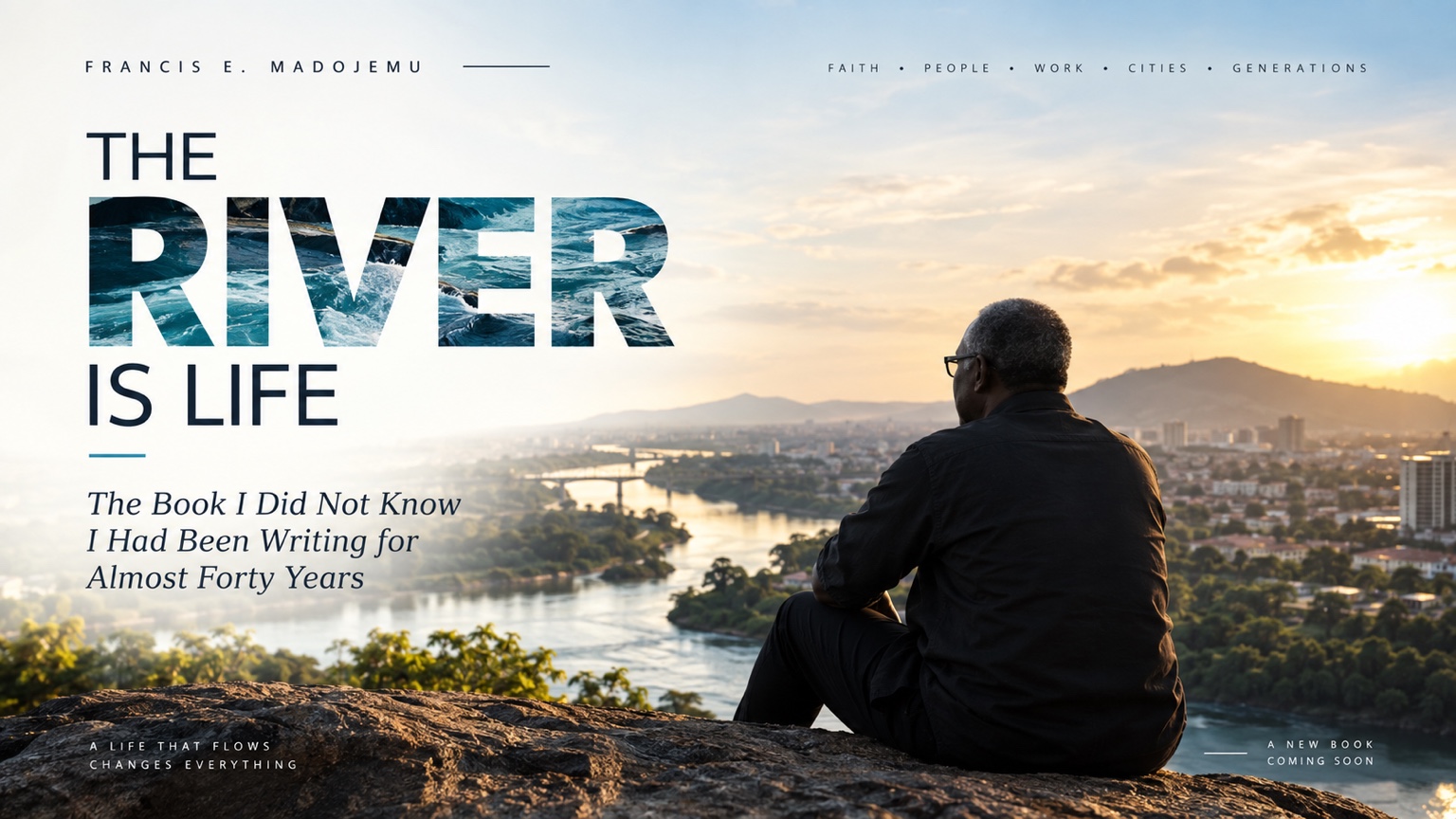
The Book I Did Not Know I Had Been Writing for Almost Forty Years
By Francis E. Madojemu
Something rather extraordinary has been happening to me.
I have been working on a new book.
Except that I am no longer entirely sure that “working on a new book” is the right way to describe what has happened.
It feels more like I have discovered a book that has been waiting for me.
After almost forty years of walking with God, preaching, pastoring, building, working with people, starting things, watching some succeed and others fail, wrestling with the Church and continually asking what Christianity is supposed to mean for the world outside our buildings, I encountered a very simple picture.
A river.
Not a new doctrine.
Not another church programme.
Not a clever leadership model.
Just a river.
And the longer I looked at it, the more disturbing—and liberating—it became.
Because a river is alive because it flows.
It receives, but it does not merely keep.
It carries.
It moves.
It crosses boundaries.
It enters territories that did not produce it.
It takes what it has received somewhere else.
And life appears downstream.
That simple picture began asking me questions.
Questions about my life.
Questions about leadership.
Questions about the Church.
Questions about the Holy Spirit.
Questions about calling.
Questions about Africa.
Questions about the next generation.
Questions about what I am supposed to do with whatever years remain ahead of me.
And perhaps the most unsettling question of all:
What if we have spent too much time teaching people how to come to the River, and not enough time asking where the River is trying to go?
That question has begun rearranging things for me.
And The River Is Life was born.
EVERYONE CANNOT KEEP DRINKING FROM MY CUP
Some time ago, I came across a statement attributed to Andy Stanley:
“As leaders, we are never responsible for filling anyone else’s cup. Our responsibility is to empty ours.”
Something about that stayed with me.
Empty your cup.
Give what you have.
Pour it out.
Teach what you know.
Share what you have learned.
Open the doors you can open.
Tell the stories.
Make the introductions.
Build the platforms.
Create opportunities.
Prepare people.
But eventually another question emerges:
What happens after you have been emptying your cup into the same people for years?
Do they simply return tomorrow with their cups again?
And next Sunday?
And next year?
And ten years from now?
At what point does what they have received begin to flow through them?
That question is particularly personal for me because I am thinking seriously about succession.
I have said prophetically to our church that I believe there is work ahead of me that they may not yet fully understand.
That conviction has become stronger rather than weaker.
It may be that I have taken some people as far as I am supposed to take them.
Perhaps another leader must continue parts of their development.
And perhaps I must increasingly turn my face outward.
Not because I love the Church less.
Perhaps because the River is asking me to love the world more.
There is a difference.
THE CANDLE DOES NOT LIGHT ITSELF
Another picture began to connect.
A candle.
A candle receives fire, but the purpose of the fire is not ultimately the candle.
The candle carries something that allows somebody else to see.
That is remarkably simple.
But think about what it means.
If I spend my entire life celebrating the fact that my candle is burning, but nothing around me becomes more visible, what exactly has the fire accomplished?
Perhaps the evidence of light is not excitement around the candle.
Perhaps it is what can now be seen because the candle is burning.
And suddenly the River and the candle began saying the same thing to me.
What you carry is not merely for you.
The question is not simply:
What have I received?
The deeper question is:
What is receiving life because I received it?
AND THEN THERE WERE BOATS
Once you see a river, you eventually notice the boats.
This has become one of the most important parts of the picture for me.
For years, our instinct in church leadership has often been to build everything around the institution.
We gather people.
Train people.
Develop people.
Organise people.
And then, if we are not careful, we spend enormous energy finding increasingly elaborate ways for those same people to serve the institution that trained them.
But what if that is incomplete?
What if the Church is not supposed to own every boat?
What if some boats are supposed to leave?
What if somebody within our network is supposed to build a university?
Not a “church university” controlled by a church committee.
A great university.
What if somebody builds a bank?
A technology company?
A media platform?
A school?
An artificial-intelligence venture?
A design practice?
A manufacturing company?
A farm?
A cultural institution?
What if those institutions carry the values and life of the Kingdom precisely because Spirit-led people built them well?
The boats do not all have to look alike.
They do not all have to carry our logo.
They do not all have to come back to headquarters for permission.
Perhaps one of the measures of a healthy harbour is the number of seaworthy vessels it is prepared to release.
That changes the way I think about Church.
And it changes the way I think about leadership.
Because the goal of leadership cannot be to make myself permanently indispensable.
If everything must continue flowing through me, I have not built a river.
I have built a bottle.
SUNDAY CANNOT BE THE DESTINATION
This has made me think again about something else we have been saying:
Sunday is the fulfilment centre.
Not the destination.
A fulfilment centre receives things, sorts them, prepares them and sends them somewhere.
What if our gatherings functioned more like that?
People come in from the world.
Some arrive bruised.
Some confused.
Some empty.
Some exhausted.
Some successful but directionless.
Some carrying extraordinary gifts they have never understood.
We worship.
We pray.
We encounter God.
We hear His Word.
We encourage one another.
We are corrected.
We are healed.
We are equipped.
And then the doors open.
The River flows out again.
Monday matters.
The boardroom matters.
The classroom matters.
The construction site matters.
The studio matters.
The laboratory matters.
The market matters.
The farm matters.
The courtroom matters.
The technology hub matters.
The government office matters.
The home matters.
The street matters.
The city matters.
If Christianity works wonderfully inside our sanctuaries but leaves the world immediately surrounding those sanctuaries largely untouched, we have to be willing to ask difficult questions.
Perhaps we have confused gathering with arrival.
THEN I SAW THE RIVER RUNNING THROUGH MY OWN WORK
This was when the idea became even more uncomfortable.
Because I began looking at things I was already doing.
Why have I remained fascinated by architecture?
Why cities?
Why systems?
Why entrepreneurship?
Why education?
Why technology?
Why young people?
Why culture?
Why have I continued trying to build things outside the conventional boundaries of church ministry?
Why AI Saturdays?
Why Market Day Live?
Why the continuing fascination with helping ordinary people turn knowledge, skills and products into economic value?
Why build spaces where worship, business, learning, culture, technology and community continually bump into one another?
Perhaps these were not distractions from ministry.
Perhaps I had simply inherited too small a definition of ministry.
That possibility has disturbed me.
Because it means that some of the things we call “secular” may simply be places where the River has not yet been recognised.
THE RIVER MUST ENTER THE CITY
I am an African.
I have lived and worked in Nigeria.
I know our contradictions.
I have watched extraordinary churches flourish beside broken infrastructure.
I have seen passionate worship in cities where ordinary citizens struggle with systems that should work but do not.
I have seen gifted young people learn to compensate for institutional failure with extraordinary ingenuity.
I have watched craftsmen work without the tools, systems, capital and respect that could multiply their productivity.
I have watched entrepreneurs struggle not because they lack ideas but because the architecture around enterprise is weak.
And I keep returning to a difficult question:
If there is this much Christianity, where is the corresponding life?
Where is it in education?
Where is it in enterprise?
Where is it in government?
Where is it in sanitation?
Where is it in design?
Where is it in public administration?
Where is it in technology?
Where is it in agriculture?
Where is it in the dignity of work?
Where is it in the systems by which ordinary people live?
Where is it in our cities?
This is not an accusation against the Church.
I am part of the Church.
It is a question to the Church.
And first, it is a question to me.
Perhaps the River was never supposed to terminate at the altar.
Perhaps the altar was where we learned how to carry it.
YOU WALK DIFFERENTLY WHEN YOU KNOW WHAT YOU ARE CARRYING
There is a very ordinary African image that has helped me think about this.
A woman carrying a bucket of water on her head.
Often there is a small circular support underneath it—what we commonly call an oshupa—helping her balance the load.
Watch her walk.
Her awareness of what she carries affects everything.
Her posture changes.
Her pace changes.
She negotiates obstacles differently.
She is conscious of weight, balance and movement.
She does not have to stop every thirty seconds to check whether the bucket is still there.
She walks because she knows what she carries.
I have increasingly wondered whether this is part of what consciousness of the Holy Spirit should mean.
Not simply an occasional experience.
Not merely a moment during worship.
Not simply goosebumps or manifestations.
Presence carried into ordinary life.
You enter the office differently.
You negotiate differently.
You employ people differently.
You design differently.
You teach differently.
You build differently.
You lead differently.
You spend differently.
You solve problems differently.
You treat people differently.
Because you know Who you carry.
And you begin to understand that wherever you go, the River can go.
CREATION IS WAITING
Then something in Romans 8 began opening differently to me.
Paul speaks of creation groaning.
Waiting.
Longing for something to appear.
He says creation waits eagerly for the manifestation—the revealing—of the children of God.
But within that same extraordinary chapter, Paul tells us who these children are:
Those who are led by the Spirit of God are the children of God.
Put those thoughts beside one another.
Creation is waiting for the children of God.
The children of God are those led by the Spirit of God.
Then perhaps creation is waiting for Spirit-led people.
That takes the conversation immediately outside the church building.
The world needs Spirit-led pastors.
Certainly.
But why would it stop there?
What about Spirit-led architects?
Spirit-led entrepreneurs?
Spirit-led teachers?
Spirit-led engineers?
Spirit-led artists?
Spirit-led lawyers?
Spirit-led civil servants?
Spirit-led politicians?
Spirit-led technologists?
Spirit-led farmers?
Spirit-led craftsmen?
Spirit-led parents?
Spirit-led citizens?
People carrying the life of God into the places where creation is groaning.
Where there is disorder, bringing order.
Where there is injustice, pursuing justice.
Where there is ugliness, creating beauty.
Where systems fail, building better systems.
Where people are excluded, creating access.
Where knowledge is absent, teaching.
Where enterprise is weak, creating value.
Where hope is disappearing, carrying possibility.
Perhaps that is manifestation.
Perhaps the world is not merely waiting to hear what we believe.
Perhaps it is waiting to experience what happens when what we believe becomes flesh in the way we live and work.
PERHAPS WE HAVE BEEN CALLING THE HARVEST “UNBELIEVERS”
That led me somewhere else.
We Christians have developed our own language.
One of our familiar categories is unbelievers.
I increasingly find myself uncomfortable with it.
I have preferred non-believers.
But even that may still be looking from our side of the divide.
Because when Jesus looked at people, one of the great pictures He used was different.
Harvest.
That changes everything.
An “unbeliever” can become someone I classify.
Harvest is something I move toward.
An unbeliever can become someone from whom I separate myself.
Harvest creates urgency, compassion and possibility.
Jesus saw people who needed shepherding.
He saw fields ready for harvest.
He moved toward people.
And rivers do the same thing.
They move toward places that need life.
So perhaps the question is not simply how we can persuade the world to come into our buildings.
Perhaps another question is:
Why isn’t the River reaching them where they already are?
A RIVER ALSO NEEDS BANKS
Eventually another problem appeared.
It is easy to become excited about flow.
But water without boundaries can become a flood.
A river needs banks.
Life needs form.
Vision needs structure.
Calling needs discipline.
Good intentions need systems.
Life needs architecture.
This is one reason the book eventually began moving into territory I had not initially expected.
Order.
Work.
Craftsmanship.
Systems.
Institutions.
Execution.
Because prayer is indispensable, but prayer is not a substitute for obedience.
And obedience can be surprisingly practical.
Sometimes obedience looks like a spreadsheet.
A process.
A timetable.
A properly maintained machine.
A trained worker.
A functioning school.
A transparent account.
A good business model.
A reliable supply chain.
A well-designed building.
A system that actually works when ordinary people need it.
We sometimes separate these things from spirituality.
I am no longer convinced God does.
Order gives life a channel.
And when life has a channel, it can travel farther than charisma ever could.
AND THEN GOD SENT ME A BUTTERFLY
While all this was developing, another image returned with extraordinary force.
The monarch butterfly.
I had already been thinking and writing about its remarkable generational migration.
The journey is so large that a single generation does not complete the entire migration cycle.
One generation travels.
Another continues.
Another carries forward what it inherited.
The journey is bigger than any individual butterfly.
And suddenly the butterfly seemed to be explaining the River to me.
Some journeys are designed to be generational.
That is difficult for founders.
It is difficult for pastors.
It is difficult for entrepreneurs.
It is difficult for parents.
It is difficult for anyone who has spent decades building something.
We want to finish.
God may be asking us to transfer.
We want completion.
God may be thinking generations.
We want to arrive.
God may simply be asking us to travel faithfully for our part of the journey.
That changes succession.
Succession is no longer merely about replacing a leader.
It becomes part of the architecture of life.
A generation receives something it did not originate.
Carries it faithfully.
Adds what it can.
And passes it on.
The River does not stop because I leave the bank.
In fact, perhaps one of the final responsibilities of leadership is to make sure it doesn’t.
THE JOURNEY IS BIGGER THAN YOU
That sentence now means much more to me.
I am beginning to understand that some things I have been building may not reach their fullest expression in my lifetime.
That no longer frightens me as much as it once might have.
The university someone builds may begin with a conversation we are having now.
The company may be founded by somebody currently sitting quietly in church.
The technology that changes an industry may come from a young person we merely helped believe that their gift mattered.
The institution may carry no resemblance to us at all.
Good.
The boat is not supposed to become the harbour.
And perhaps the greatest evidence that we succeeded will be things flourishing downstream whose names are not ours.
THEN SOMETHING HAPPENED NEAR THE END
This is where I need to be careful.
Because while writing The River Is Life, something happened that changed the entire book.
I had followed the River through leadership.
Through Church.
Through calling.
Through work.
Through Africa.
Through cities.
Through systems.
Through generations.
Through succession.
Through my own life.
And then, quite late in the journey, I returned to Scripture and saw something that stopped me.
I am deliberately not going to explain it fully here.
It belongs to the final movement of the book.
But I can tell you this:
The River has a Source.
And then came the discovery that affected me even more:
The Source is also Home.
Suddenly the journey that had seemed to be about going outward was also a journey homeward.
The River had been carrying much more than I realised.
And passages of Scripture I had known for years began to look different.
That is where I want the reader to arrive for themselves.
So I will leave the River there for now.
THE RIVER IS LIFE
That is the book that is coming.
THE RIVER IS LIFE
The Holy Spirit, Calling, and the Life That Must Flow
It may be the most personal thing I have written.
And strangely, perhaps the most outward-looking.
It is about the Holy Spirit, but perhaps not quite in the way you expect.
It is about Church, although much of the journey takes place outside church.
It is about calling, but it asks what happens when calling puts on work clothes.
It is about Africa.
Cities.
Systems.
Craftsmanship.
Institutions.
Fathers and children.
Leadership.
Succession.
Generations.
Boats that eventually have to leave the harbour.
A butterfly that cannot complete its journey in one generation.
And a River that was flowing long before any of us arrived.
I began this journey thinking I was discovering an idea.
Increasingly, I wonder whether the idea was discovering me.
And perhaps that is why I want to share the book now, even before it is released.
Because the questions are already worth asking:
What am I carrying?
Where is it supposed to go?
What has God placed in me that was never intended to terminate with me?
Where have I mistaken gathering for destination?
Which boats am I still holding that I should have released?
What part of the world’s groaning am I actually equipped to answer?
What must I build so that life can flow?
What must I hand to another generation?
And finally:
Where is the River taking me now?
I don’t think those questions belong only to pastors.
I think they belong to all of us.
The River is moving.
Perhaps the invitation is not to stand on the bank explaining it.
Perhaps the invitation is much simpler.
Get in the River.
THE RIVER IS LIFE
The Holy Spirit, Calling, and the Life That Must Flow
A new book by Francis E. Madojemu.
Coming soon.